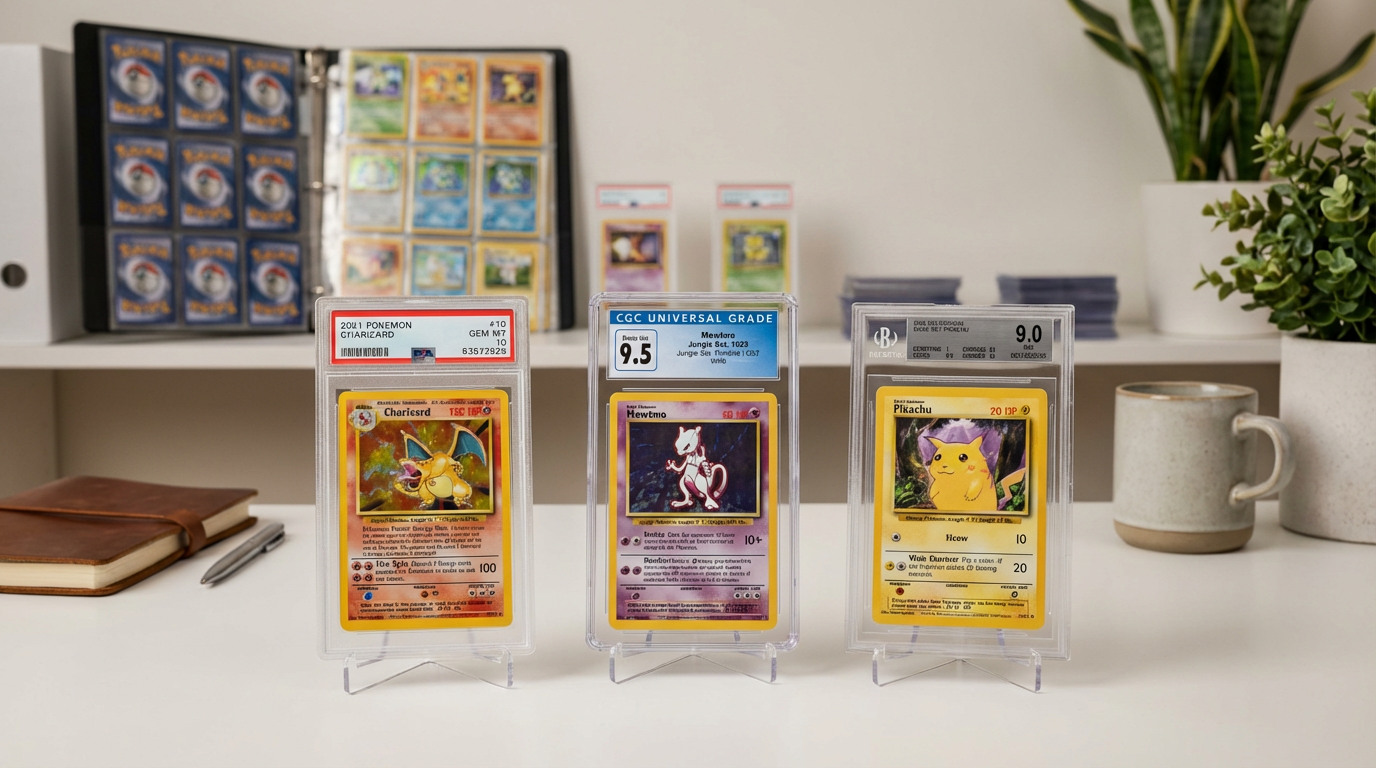
PSA vs CGC vs BGS: Best Pokemon Card Grading Service 2026
Choosing the right grading company for your Pokemon cards can mean the difference between maximizing your collection's value and leaving thousands of dollars on the table. With PSA dominating 70% of the market, CGC offering competitive pricing, and BGS now under the same ownership umbrella as PSA, the grading landscape has never been more complex—or more important to understand.
In this comprehensive guide, we'll break down everything you need to know about PSA, CGC, and BGS grading for Pokemon cards, including current pricing, turnaround times, resale values, and which service makes the most sense for your specific cards. Whether you're grading a vintage Charizard or modern chase cards, this data-driven comparison will help you make the smartest decision.
The Current State of Pokemon Card Grading (2026)
The Pokemon card grading industry experienced a seismic shift in December 2025 when Collectors—PSA's parent company—acquired Beckett Grading Services. This consolidation means that Collectors now controls approximately 79% of the grading market through PSA, SGC, and Beckett combined.
This leaves CGC as the only major independent grading competitor, a position that has both challenges and opportunities. CGC processed 1.9 million cards in 2024, representing 36% year-over-year growth, and has positioned itself as a credible alternative with competitive pricing and faster turnaround times.
The Pokemon market itself remains incredibly strong. PSA graded 97 of the top 100 trading cards in the first half of 2025, with Pokemon accounting for the vast majority. Overall, 7.2 million TCG and non-sports cards were graded in H1 2025—a 70% increase year-over-year and representing 59% of all graded cards.
Why This Matters for Your Cards
With Pokemon's 30th Anniversary driving unprecedented collector interest in 2026, understanding which grading service maximizes your cards' value has never been more critical. The right choice depends on your goals: maximizing resale value, getting the fastest turnaround, or obtaining the most detailed assessment of your card's condition.
PSA: The Market Leader
Market Dominance and Recognition
PSA (Professional Sports Authenticator) remains the undisputed king of Pokemon card grading, with over 70% of all graded Pokemon cards carrying the iconic PSA label. This market dominance translates directly into higher resale values, as collectors and investors overwhelmingly prefer PSA-graded cards.
The brand recognition is unmatched. When a buyer sees a PSA 10 Charizard, they know exactly what they're getting, and they're willing to pay a premium for that certainty. This market preference has created a self-reinforcing cycle where PSA cards sell for more, encouraging more people to use PSA, which further cements their market position.
Current PSA Pricing (2026)
PSA increased prices in September 2025 due to unprecedented demand:
- Value Bulk: $21.99 per card (up from $19.99)
- Value: $27.99 per card
- Value Plus: $44.99 per card
- Express and Super Express: Premium pricing for faster service
These price increases reflect the massive demand for grading services, particularly for Pokemon cards. While PSA is no longer the cheapest option, many collectors consider the premium worthwhile for the resale value advantage.
Turnaround Times
Current PSA turnaround times range from 25-65 business days for economy tiers, though these can extend during peak periods. The September 2025 price increases and extended timelines were implemented specifically to manage overwhelming submission volumes.
For time-sensitive submissions—such as newly released chase cards where being first to market matters—PSA offers expedited services at significantly higher price points.
PSA Grading Standards
PSA uses a straightforward 1-10 scale with no half-grades:
- PSA 10 (Gem Mint): Near-perfect card with only minor flaws allowed
- PSA 9 (Mint): Slight imperfections but still excellent condition
- PSA 8 (Near Mint-Mint): Minor wear but overall attractive
PSA's grading standards are generally considered moderate—stricter than SGC but more lenient than CGC. This balance has contributed to their popularity, as collectors have a reasonable chance of achieving high grades on quality cards.
Resale Value Advantage
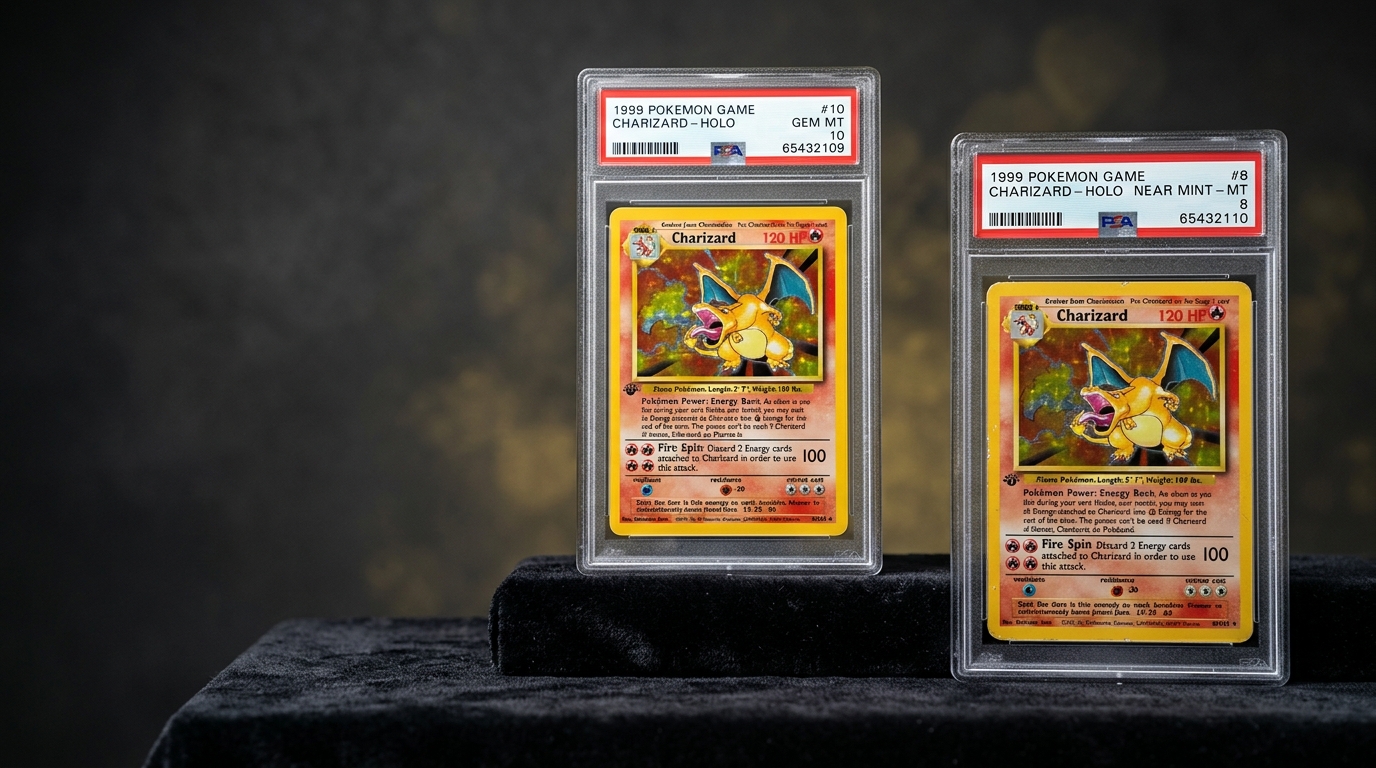
This is where PSA truly shines. PSA 10 cards consistently command the highest market prices across virtually all Pokemon sets and rarities. A PSA 10 Base Set Charizard can sell for 5-10x more than its raw counterpart, and the PSA premium over other grading companies typically ranges from 10-30% for comparable grades.
You can track these price differences in real-time using pokemonpricetracker.com's graded card price tracking, which pulls eBay sales data for PSA, CGC, BGS, and SGC graded cards. The platform's price history charts clearly show the PSA premium across different cards and grades.
When to Choose PSA
Best for:
- High-value vintage cards (Base Set, Jungle, Fossil holos)
- Cards you plan to sell or flip
- Building a collection focused on resale value
- Cards likely to grade PSA 9 or 10
- Long-term investment pieces
Skip PSA if:
- You need fast turnaround times
- You're on a tight budget
- You're grading modern bulk cards with lower individual value
CGC: The Independent Alternative
Market Position and Growth
CGC (Certified Guaranty Company) entered the Pokemon card grading market later than PSA and BGS but has rapidly gained ground. As the only major independent grading company following the Collectors-Beckett merger, CGC offers collectors an alternative outside the consolidated market.
CGC's 36% year-over-year growth in 2024, processing 1.9 million cards, demonstrates strong market acceptance. The company has invested heavily in technology, customer service, and brand building to compete with PSA's dominance.
Current CGC Pricing (2026)
CGC remains the most affordable option among major grading companies:
- Economy tiers: Starting at approximately $12-15 per card
- Standard service: $20-25 per card
- Express options: Available at premium pricing
This 30-45% price advantage over PSA makes CGC attractive for collectors grading larger volumes or lower-value cards where PSA's premium pricing doesn't make economic sense.
Turnaround Times
CGC consistently offers the fastest turnaround times at economy service levels, often completing submissions in 20-40 business days. This speed advantage, combined with lower pricing, makes CGC particularly appealing for modern card releases where timing matters.
For collectors looking to grade and flip newly released chase cards, CGC's combination of speed and cost-effectiveness can maximize profitability even with the smaller resale premium compared to PSA.
CGC Grading Standards
CGC is known for stricter grading standards than PSA:
- CGC 10 (Pristine): Exceptionally rare, near-impossible perfection
- CGC 9.5 (Gem Mint): What most consider "perfect" condition
- CGC 9 (Mint): Excellent condition with minor flaws
CGC offers half-grades (9.5, 8.5, etc.), providing more granularity than PSA's whole-number system. In 2024, CGC made a strategic change by relabeling their Gem Mint grade from "9.5" to "10" on the label while maintaining the same standards. This improved market perception, though experienced collectors understand a CGC 10 is roughly equivalent to a PSA 9.5 (which doesn't exist).
The Narrowing Value Gap
Historically, CGC-graded cards sold for 20-40% less than equivalent PSA grades. However, this gap has been narrowing significantly in 2024-2025. Several factors contribute to this trend:
- Increased market acceptance as more collectors recognize CGC's quality and consistency
- The label redesign making CGC 10s more visually comparable to PSA 10s
- PSA's price increases making the cost-benefit analysis more favorable for CGC
- Growing population of CGC-graded cards improving liquidity
Using pokemonpricetracker.com's grading ROI calculator, you can compare the expected value of grading a card with different companies, factoring in both grading costs and typical market premiums. This tool helps determine whether PSA's higher resale values justify the additional cost and wait time for your specific cards.
When to Choose CGC
Best for:
- Budget-conscious collectors
- Modern card releases requiring fast turnaround
- Personal collection cards where resale isn't the priority
- Cards that might grade in the 8-9 range
- Bulk submissions of mid-tier cards
- Collectors who prefer detailed, strict grading
Skip CGC if:
- You're grading ultra-high-value vintage cards for resale
- Maximum resale value is your only concern
- You're targeting serious investors who exclusively collect PSA
BGS: The Detailed Alternative
The Beckett Legacy and Current Status
Beckett Grading Services (BGS) was once PSA's primary competitor and introduced several innovations to card grading, including subgrades and the legendary Black Label. However, BGS's market share in Pokemon cards has declined over the past decade, with most collectors preferring PSA or, more recently, CGC.
The December 2025 acquisition by Collectors (PSA's parent company) raises questions about BGS's future positioning. While Collectors has stated that BGS will continue operating independently, the long-term strategy remains unclear. Some industry observers speculate that BGS may be repositioned to focus on specific niches or card categories.
The Subgrade System
BGS's defining feature is its detailed subgrade system, which evaluates four aspects of card condition:
- Centering: Front and back centering measurements
- Corners: Sharpness and wear on all four corners
- Edges: Condition of all card edges
- Surface: Print quality, scratches, and surface defects
Each subgrade receives a score from 1-10, and these are averaged (with some weighting) to determine the overall grade. This transparency appeals to serious collectors who want to understand exactly why a card received its grade.
The Black Label 10
The BGS Black Label 10 represents the absolute pinnacle of card grading—a perfect 10 in all four subgrades. These are extraordinarily rare, with some estimates suggesting less than 1% of submitted cards achieve this grade.
Black Label 10s command astronomical prices, often exceeding even PSA 10s by significant margins. A Black Label 10 of a desirable Pokemon card can sell for 2-5x the price of a PSA 10 of the same card. However, the odds of achieving this grade are so low that it's not a realistic goal for most submissions.
BGS Pricing and Turnaround
BGS pricing is generally comparable to PSA:
- Standard service: $25-35 per card
- Express service: 2-3 business days at premium pricing ($150+ per card)
- Subgrade options: May incur additional fees
Turnaround times vary widely depending on service level, from a few days for express service to 30-60+ days for economy tiers.
Resale Value Considerations
For Pokemon cards specifically, BGS grades typically sell for:
- BGS 9.5: Usually 10-25% less than PSA 10
- BGS 10: Comparable to or slightly above PSA 10
- Black Label 10: Significantly above PSA 10 (2-5x premium)
The challenge is that achieving a BGS 10 or Black Label is significantly harder than achieving a PSA 10, making the risk-reward calculation complex. You can use pokemonpricetracker.com's population reports to see how many cards have been graded at each level by each company, giving you a sense of the relative difficulty and rarity.
When to Choose BGS
Best for:
- Cards you believe could achieve Black Label 10
- Collectors who value detailed condition assessment
- Sports card collectors also grading Pokemon (BGS is stronger in sports)
- Cards where subgrades tell an important story
- Personal collection showcase pieces
Skip BGS if:
- You're grading cards likely to receive 9 or below
- You want the broadest market appeal for resale
- You're primarily focused on Pokemon (PSA dominates this market)
- You're concerned about the company's future direction post-acquisition
Head-to-Head Comparison
Pricing Comparison (Economy/Value Tiers)
| Company | Price Per Card | Value Proposition |
|---|---|---|
| PSA | $21.99-$27.99 | Highest resale value |
| CGC | $12-$15 | Best budget option |
| BGS | $25-$35 | Detailed subgrades |
Turnaround Time Comparison
| Company | Economy Service | Express Options |
|---|---|---|
| PSA | 25-65 business days | Available at premium |
| CGC | 20-40 business days | Fastest overall |
| BGS | 30-60 business days | 2-3 days available |
Grading Standards (Strictness)
- CGC - Strictest (hardest to achieve high grades)
- BGS - Strict (especially for Black Label)
- PSA - Moderate (balanced approach)
Resale Value Premium (vs. Raw)
For a card worth $100 raw:
PSA 10: $500-$1,000 (5-10x multiplier) CGC 10/9.5: $400-$800 (4-8x multiplier, gap narrowing) BGS 9.5: $400-$700 (4-7x multiplier) BGS Black Label 10: $1,000-$2,000+ (10-20x multiplier)
Note: These are general estimates. Actual multipliers vary significantly by card, set, and market conditions.
Making the Right Choice: Decision Framework
For Vintage High-Value Cards ($500+ Raw Value)
Best Choice: PSA
For vintage Pokemon cards like Base Set holos, Wizards of the Coast era cards, and other high-value vintage pieces, PSA is almost always the right choice. The resale premium easily justifies the higher cost and longer wait times.
Use pokemonpricetracker.com's price history charts to compare historical sales data for PSA vs. CGC vs. BGS grades of comparable cards. This data-driven approach removes guesswork from your decision.
Consider BGS if: You have a truly pristine card that could achieve Black Label 10, though the odds are extremely low.
For Modern Chase Cards (Recent Releases)
Best Choice: CGC or PSA
For modern cards from recent sets, the decision depends on your timeline and goals:
- Choose CGC if you want to grade and sell quickly while the card is hot
- Choose PSA if you're building a long-term collection or can wait for maximum value
Modern cards often see rapid price fluctuations, so CGC's faster turnaround can capture value that might erode during PSA's longer processing time.
For Personal Collection (Not for Resale)
Best Choice: CGC
If you're grading cards to preserve and display them in your personal collection with no plans to sell, CGC offers the best value proposition. You'll save 30-45% on grading costs while still getting professional authentication and protection.
CGC's stricter standards also mean that a CGC 9.5 or 10 is a genuine achievement, which many collectors find more satisfying than PSA's more lenient approach.
For Bulk/Mid-Tier Cards ($50-$200 Raw Value)
Best Choice: CGC
For cards in the mid-value range, the math often favors CGC. At $12-15 per card vs. PSA's $22-28, you can grade nearly twice as many cards for the same budget. While you'll sacrifice some resale premium, the lower cost improves your overall ROI.
The grading ROI calculator on pokemonpricetracker.com is invaluable here. Input your card's raw value, estimated grade, and grading costs to see which company offers the best expected return.
For Bulk Modern Commons/Uncommons
Best Choice: Don't Grade
For most modern commons and uncommons, even those in perfect condition, the economics of grading simply don't work. A $2 card that costs $15-22 to grade needs to sell for at least $20-25 just to break even.
Focus your grading budget on cards where the multiplier effect makes sense—typically cards worth at least $30-50 in raw condition.
Understanding Population Reports
Population reports show how many cards of each type have been graded at each level by each company. This data is crucial for understanding:
- Rarity: Fewer high-grade examples = higher value
- Grading difficulty: What percentage of submissions achieve each grade
- Market saturation: How many copies are competing with yours
Pokemonpricetracker.com's population reports aggregate data from PSA, CGC, and BGS, allowing you to compare populations across companies. A card with 50 PSA 10s but only 5 CGC 10s tells you something important about relative grading standards.
For investment-grade cards, lower populations generally correlate with higher values, though this relationship isn't linear. The difference between 10 and 20 PSA 10s matters much more than the difference between 1,000 and 1,010.
The Investment Perspective
Many collectors grade cards as investments, hoping to profit from appreciation over time. If this describes your goals, consider these factors:
PSA's Liquidity Advantage
PSA-graded cards are significantly more liquid than CGC or BGS alternatives. More buyers actively seek PSA cards, which means:
- Faster sales when you're ready to exit
- More competitive bidding driving higher prices
- Less negotiation on price (market is well-established)
For investment purposes, liquidity is often as important as absolute price. A CGC card worth $500 that takes 6 months to sell may be less attractive than a PSA card worth $550 that sells in 2 weeks.
The Authentication Value
All three companies provide authentication services that protect against counterfeits—an increasingly important consideration as high-quality fakes enter the market. From this perspective, any of the three major companies provides value.
However, PSA's market dominance means their authentication carries the most weight with buyers. A PSA slab provides maximum confidence, which translates to pricing power.
Long-Term Market Positioning
The Collectors acquisition of Beckett creates uncertainty about the long-term competitive landscape. Some considerations:
- Will BGS remain independent or be consolidated with PSA?
- Does CGC's independence make it more or less attractive long-term?
- How will market share evolve over the next 3-5 years?
For cards you plan to hold for 5+ years, PSA's entrenched market position provides the most certainty, though CGC's growing acceptance could shift this calculation.
Note: Past performance does not guarantee future results. Always do your own research before making investment decisions.
Practical Tips for Submission
Pre-Grade Your Cards
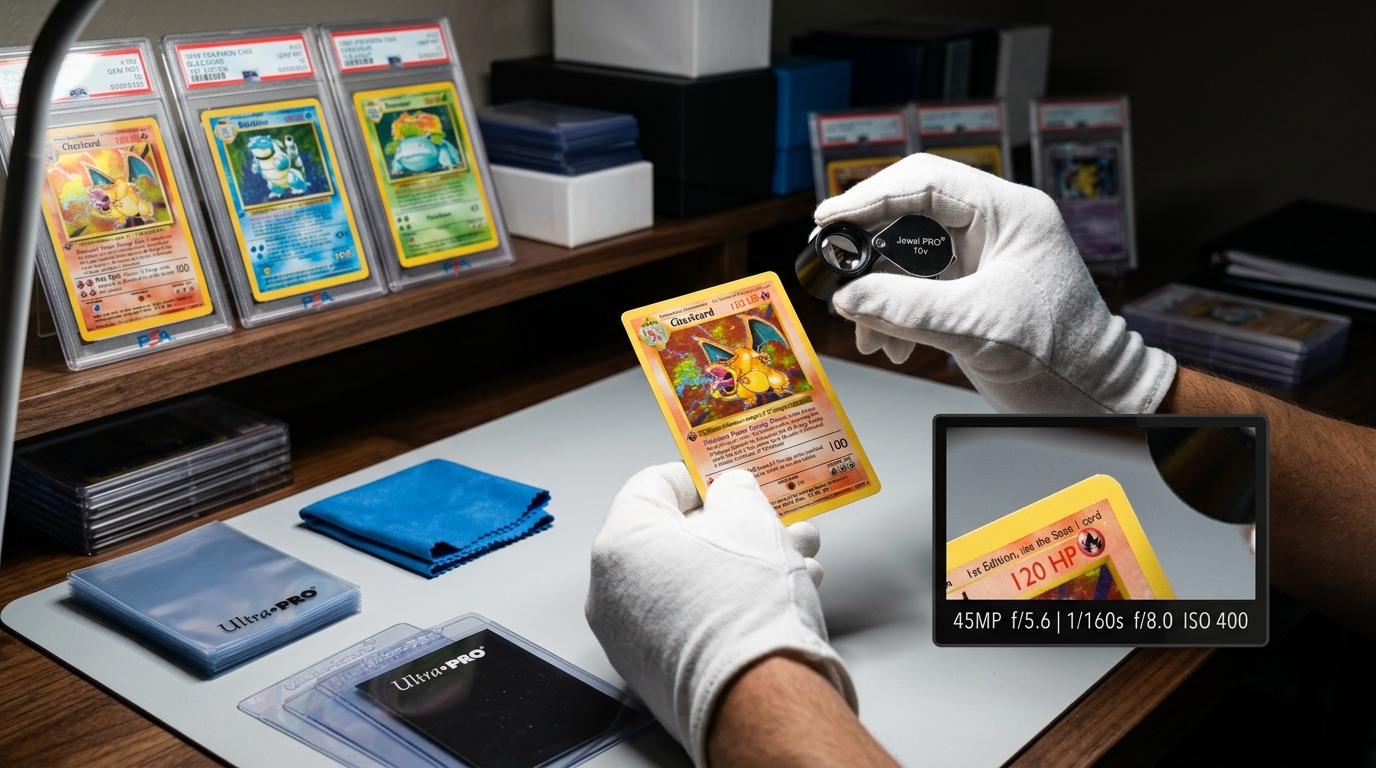
Before submitting cards for grading, carefully examine them yourself:
- Use a jeweler's loupe to inspect edges and corners
- Check centering with a ruler (60/40 or better front and back for PSA 10)
- Look for surface scratches under bright light
- Examine for print lines or defects
Only submit cards you believe have a realistic chance of grading 9 or higher. Use pokemonpricetracker.com's grading ROI calculator to determine the minimum grade needed to break even on grading costs.
Proper Packaging
All three companies have specific packaging requirements:
- Use card savers (not top loaders) for individual cards
- Sleeve cards in penny sleeves first
- Don't tape card savers closed
- Include proper submission forms
- Insure shipments appropriately
Improper packaging can result in rejected submissions or, worse, damage during transit or processing.
Batch Similar Cards
To maximize efficiency:
- Submit cards of similar value together (use the same service tier)
- Group by set or era for easier tracking
- Consider timing submissions around price increases or promotions
Track Your Submissions
All three companies provide online tracking:
- PSA: Order status updates through your account
- CGC: Detailed tracking with email notifications
- BGS: Order tracking through Beckett website
Set up notifications so you know when your cards are received, graded, and shipped back.
The Future of Pokemon Card Grading
Several trends will shape the grading landscape in 2026 and beyond:
AI and Technology Integration
Grading companies are exploring AI-assisted grading to improve consistency and speed. CGC has been particularly aggressive in adopting technology, which could help them compete with PSA's scale advantages.
Market Consolidation Effects
The Collectors-Beckett merger will take time to fully play out. Potential scenarios include:
- BGS focusing on sports cards while PSA dominates Pokemon
- BGS being rebranded or consolidated into PSA
- Collectors maintaining separate brands to avoid monopoly concerns
CGC's Independence
As the only major independent grading company, CGC could benefit from collectors seeking alternatives to the Collectors ecosystem. Their growth trajectory suggests strong market acceptance.
Authentication Technology
As counterfeit cards become more sophisticated, authentication will become even more critical. Companies investing in advanced authentication technology (holograms, blockchain tracking, etc.) will have competitive advantages.
Conclusion: Which Grading Company Should You Choose?
There's no universal "best" grading company for Pokemon cards—the right choice depends on your specific cards, goals, and circumstances:
Choose PSA if:
- You're grading high-value vintage cards
- Maximum resale value is your priority
- You're building an investment-focused collection
- You can afford the premium pricing and wait times
Choose CGC if:
- You're on a budget or grading larger volumes
- You need faster turnaround times
- You're grading modern cards for quick flips
- You're building a personal collection
- You value strict, detailed grading
Choose BGS if:
- You want detailed subgrades
- You have a truly pristine card targeting Black Label
- You collect across sports and TCG categories
- You value the Beckett brand legacy
For most collectors, a hybrid approach makes sense: use PSA for your most valuable vintage cards, CGC for modern cards and bulk submissions, and BGS selectively for special pieces where subgrades add value.
Remember to leverage the tools available on pokemonpricetracker.com:
- Price history charts to compare graded card values across companies
- Grading ROI calculator to determine if grading makes financial sense
- Population reports to understand rarity and grading difficulty
- Real-time pricing data from TCGPlayer and eBay to track market trends
By combining data-driven analysis with the insights in this guide, you'll make informed grading decisions that maximize the value and enjoyment of your Pokemon card collection.
Whether you're preserving childhood memories, building a showcase collection, or investing in the Pokemon market, professional grading protects your cards and validates their condition. Choose the company that aligns with your goals, submit with confidence, and enjoy the satisfaction of seeing your cards professionally preserved in their protective slabs.
Tags:

Team
Pokemon Market Experts
Related Articles
How to Grade Pokemon Cards: Step-by-Step 2026 Guide
Learn how to grade Pokemon cards in 2026 with this complete step-by-step guide covering PSA's paused Value tiers, the $79.99 minimum, pre-screening techniques, and when grading still makes financial sense.
Pokemon Price Tracker
PSA 10 vs PSA 9: 2026 Price Gap Analysis & ROI Data
PSA 10s command 3x to 20x more than PSA 9s in 2026, but the gap varies wildly by card and era. We break down real sales data, ROI frameworks, and when grading actually makes financial sense.
Pokemon Price Tracker

Japanese vs English Pokemon Cards: Which Holds Value in 2026?
The Japanese vs English Pokemon card debate has fundamentally shifted in 2026. Japanese PSA 10s now command 20-40% premiums over English equivalents, while raw English cards still cost 2x-6x more. Here's how to navigate both markets strategically.
Pokemon Price Tracker
Stay Updated
Subscribe to our newsletter for the latest Pokemon card market trends, investment opportunities, and exclusive insights delivered straight to your inbox.