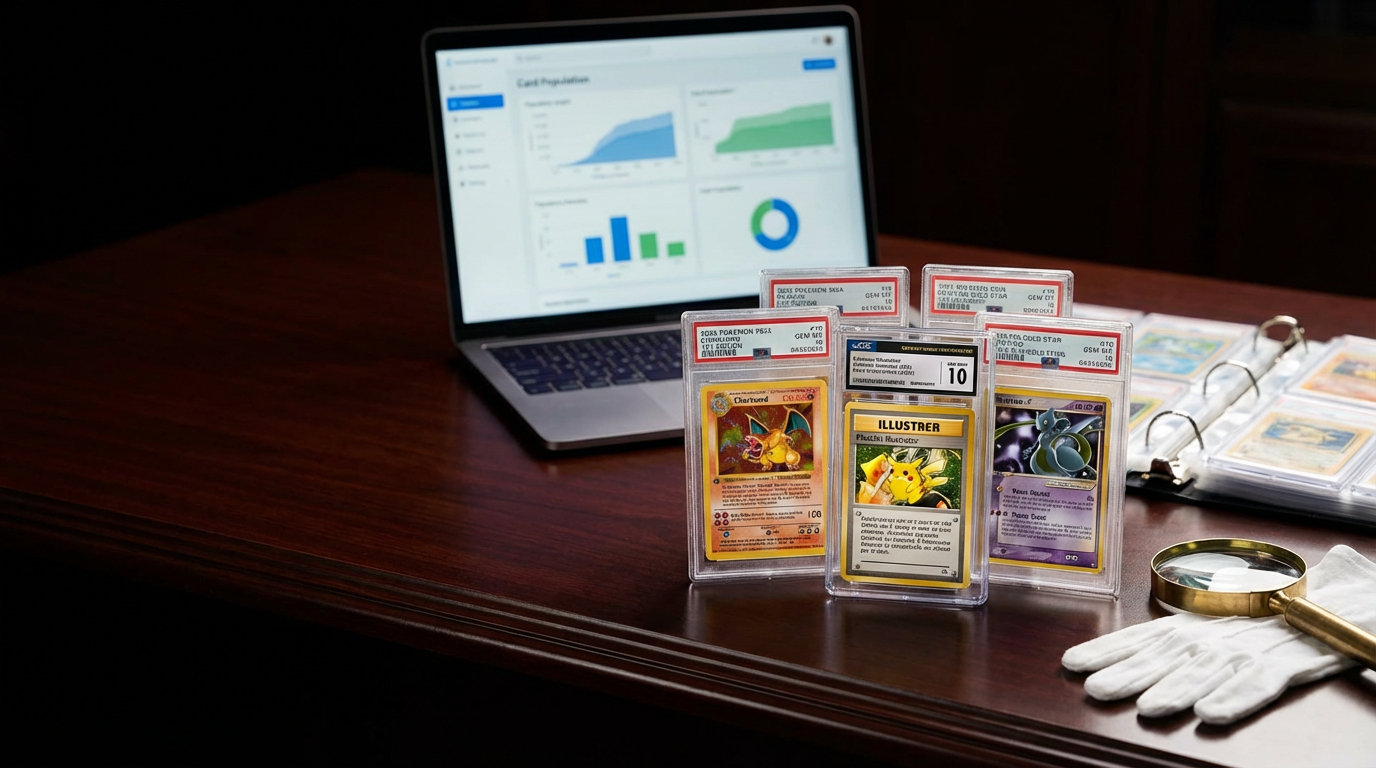
Pokemon Card Pop Report 2026: Find Rare Graded Cards
In Pokemon's 30th anniversary year, understanding population reports has become essential for serious collectors and investors. When Logan Paul's PSA 10 Pikachu Illustrator sold for $16.5 million in February 2026, it wasn't just the card's rarity that drove the price—it was the documented scarcity revealed through population data. With PSA alone having graded over 100 million cards, knowing how to read and interpret population reports separates informed collectors from those gambling in the dark.
Population reports are the most powerful tool you're not using. They reveal which cards are truly rare in high grades, which are oversaturated, and where smart money is moving. This comprehensive guide will teach you everything you need to know about Pokemon card population reports in 2026.
What Is a Pokemon Card Population Report?
A population report is a census of every card submitted to a grading company. When you pay $15-$30 to grade a single card through PSA, CGC, or BGS, that submission becomes part of a permanent record. These reports track:
- Total cards graded for each specific card and set
- Grade distribution showing how many received each grade (1-10)
- Population at gem mint levels (PSA 10, CGC 10, BGS 9.5/10)
- Relative scarcity compared to other cards in the same set
The genius of population reports is that they document what collectors actually value. When thousands of people spend money to grade a specific card, it creates an honest record of market interest. Conversely, cards with low population numbers might indicate true rarity—or simply lack of collector interest.
Why Population Data Matters More in 2026
The Pokemon card market has experienced a 3,821% value increase since 2004, vastly outperforming the S&P 500's 483% growth over the same period. As institutional money and serious collectors enter the space, population data has become the foundation of informed decision-making.
Three factors make pop reports critical in 2026:
- Market maturity: With millions of cards graded, we now have statistically significant data
- Price differentiation: A PSA 10 with 50 population trades completely differently than one with 5,000 population
- Investment validation: Population reports help justify five, six, and seven-figure card purchases
Understanding the Three Major Grading Companies
PSA (Professional Sports Authenticator)
PSA dominates the Pokemon grading market with approximately 68% market share among serious collectors. Their population reports are the most comprehensive and frequently referenced.
PSA Grading Scale:
- PSA 10 (Gem Mint): Perfect or near-perfect card
- PSA 9 (Mint): Minor flaws allowed
- PSA 8 (Near Mint-Mint): Slight wear acceptable
- PSA 7 and below: Increasing visible wear
Why PSA leads:
- Highest liquidity—PSA 10s sell faster than equivalent grades from other companies
- Most established population database dating back decades
- Market premium—PSA 10s often command 20-40% more than CGC 10s for identical cards
- Universal recognition among collectors and auction houses
CGC (Certified Guaranty Company)
CGC has gained significant ground since entering the Pokemon market, now representing approximately 10% of serious collections. Their population reports are increasingly comprehensive.
CGC advantages:
- Often faster turnaround times than PSA
- Detailed subgrades available
- Growing acceptance in the market
- Competitive pricing on grading services
CGC considerations:
- Lower liquidity than PSA—cards may take longer to sell
- Less historical population data (newer to Pokemon)
- Market discount compared to PSA for equivalent grades
BGS (Beckett Grading Services)
BGS holds approximately 22% of the market, particularly strong with vintage cards and high-end collectors.
BGS unique features:
- Subgrades for centering, corners, edges, and surface
- BGS 10 (Black Label) is extremely rare and commands huge premiums
- BGS 9.5 (Gem Mint) roughly equivalent to PSA 10
- Strong reputation for consistency
BGS consideration:
- More complex grading system can confuse newer collectors
- Subgrades provide transparency but also complexity
- BGS 9.5s often sell for less than PSA 10s despite similar quality
How to Read a Pokemon Population Report
Population reports contain critical information that directly impacts card values. Here's how to interpret the data:
Key Metrics to Analyze
Total Population: The complete number of cards graded across all grades. A card with 10,000 total graded is fundamentally different from one with 100 total graded.
PSA 10 Population: The number of gem mint examples. This is often the most important single data point. A PSA 10 with 50 population will trade at a massive premium over one with 5,000 population.
PSA 9 to PSA 10 Ratio: Reveals how difficult a card is to grade perfectly. If 1,000 PSA 9s exist but only 50 PSA 10s, that card is extremely condition-sensitive.
Pop Report Trend: Is population increasing rapidly or stable? Rapidly increasing population can indicate:
- Recent price spikes driving submission volume
- Easy-to-grade cards with many mint copies available
- Potential oversaturation risk
Example: Analyzing a Real Pop Report
Let's examine a hypothetical modern card:
- Total Graded: 2,500 cards
- PSA 10: 400 cards (16% of total)
- PSA 9: 1,200 cards (48% of total)
- PSA 8 and below: 900 cards (36% of total)
Analysis: This card has a reasonable PSA 10 rate (16%), suggesting it's moderately difficult to grade perfectly. The large PSA 9 population indicates many near-mint copies exist. For investment purposes, you'd want to focus on PSA 10s, as the PSA 9 population is likely to continue growing.
Contrast with a vintage card:
- Total Graded: 500 cards
- PSA 10: 15 cards (3% of total)
- PSA 9: 100 cards (20% of total)
- PSA 8 and below: 385 cards (77% of total)
Analysis: This card is extremely difficult to find in high grade. The 3% PSA 10 rate indicates condition sensitivity, likely due to age, print quality, or centering issues. PSA 10 examples would command significant premiums.
The Rarest PSA 10 Pokemon Cards in 2026
Based on current population data, these cards represent the pinnacle of Pokemon collecting:
Vintage Era (1999-2003)
1. Pikachu Illustrator (CoroCoro Promo)
- PSA 10 Population: 1 card
- Last recorded sale: $16.5 million (February 2026)
- Why it's rare: Only 39 copies originally distributed, most in played condition
2. Tropical Mega Battle Trophy Cards
- PSA 10 Population: 0-2 cards depending on year
- Estimated value: $500,000-$1,000,000+
- Why they're rare: Tournament prizes with tiny distribution
3. No Rarity Symbol Pokémon (Base Set)
- PSA 10 Population: 5-20 cards per Pokémon
- Value range: $10,000-$100,000+
- Why they're rare: First edition printing errors, extremely limited
4. Shadowless Charizard (Base Set)
- PSA 10 Population: Approximately 150 cards
- Value: $200,000-$400,000
- Why it's valuable: Low pop despite being "common" in raw form
Modern Era (2020-2026)
1. Moonbreon (Umbreon VMAX Alternate Art)
- PSA 10 Population: Estimated 800-1,000 cards
- Value: $2,000-$3,500
- Why it matters: Despite modern printing, achieving PSA 10 is challenging
2. Japanese Eevee Heroes Alt Arts
- PSA 10 Population: 200-600 per card
- Value: $500-$2,000
- Why they're significant: Print quality issues make 10s genuinely scarce
3. Crown Zenith Lugia V Alt Art
- PSA 10 Population: 300-500 cards
- Value: $800-$1,200
- Why it's notable: Recent release but already showing condition sensitivity
Where to Find Population Report Data
Accessing population data has become easier in 2026, with several platforms offering comprehensive tools.
Official Grading Company Resources
PSA Population Report (psacard.com/pop)
- Most comprehensive historical data
- Free to access
- Updated regularly (typically weekly)
- Search by card name, set, or certification number
CGC Census (cgccards.com/census)
- Growing database of CGC-graded cards
- Includes subgrade distributions
- Free access to population data
- Less historical depth than PSA
BGS Population Report
- Available through Beckett's website
- Includes subgrade breakdowns
- Particularly useful for vintage cards
Third-Party Aggregators
Platforms like PriceCharting now offer combined population reports showing PSA and CGC data side-by-side. This unified view helps collectors compare scarcity across grading companies.
For comprehensive population data and real-time tracking, specialized Pokemon price tracking platforms provide the most user-friendly experience, often with additional analytics and historical trend data.
How Population Reports Impact Card Values
Understanding the relationship between population and price is crucial for collectors and investors.
The Scarcity Premium
Cards with low PSA 10 populations command exponential premiums:
- Pop 1-10: Ultra-rare territory, premiums of 500-1000%+ over PSA 9
- Pop 10-50: Very rare, premiums of 200-500% over PSA 9
- Pop 50-200: Rare, premiums of 100-200% over PSA 9
- Pop 200-1000: Scarce, premiums of 50-100% over PSA 9
- Pop 1000+: Common in high grade, premiums of 20-50% over PSA 9
These premiums vary by card significance, set popularity, and market conditions, but the pattern holds consistent.
Population Growth and Price Pressure
Rapidly increasing populations can signal future price pressure. When a card's PSA 10 population grows from 100 to 500 in six months, it indicates:
- Supply increase: More high-grade copies entering the market
- Submission waves: Recent price spikes encouraging more grading
- Potential oversaturation: Risk of future price decline
Example: Many modern alternate art cards saw 200-300% population increases in 2024-2025 as prices spiked. Cards that maintained value had strong underlying demand; those without saw 30-50% price corrections.
The Liquidity Factor
Lower population doesn't always mean higher value. A card with pop 5 in PSA 10 might actually be harder to sell than one with pop 500 because:
- Fewer potential buyers know the card exists
- Less price discovery and market data
- Higher risk for buyers (is it actually desirable?)
- Fewer comparable sales for valuation
The sweet spot for investment is often cards with pop 50-500 in PSA 10—rare enough to maintain premiums, common enough to have liquid markets.
Investment Strategy Using Population Reports
Note: Past performance does not guarantee future results. Always do your own research before making investment decisions.
Identifying Undervalued Cards
Population reports reveal market inefficiencies:
Strategy 1: Low Pop, High Demand Find cards with:
- PSA 10 population under 200
- Strong character or set popularity
- Current prices that don't reflect scarcity
Strategy 2: Difficult Grades Target cards with:
- Less than 10% PSA 10 rate
- Large PSA 9 populations (proving demand)
- Vintage sets with continuing interest
Strategy 3: Recent Set Gems Identify modern cards where:
- Print quality issues create genuine scarcity
- Population growth has stabilized
- Prices haven't caught up to pop report reality
Avoiding Population Traps
Red Flag 1: Rapidly Increasing Population If a card's PSA 10 pop grows 50%+ in 3-6 months, be cautious. This often precedes price corrections.
Red Flag 2: High Pop, High Price Cards with 2,000+ PSA 10s trading at significant premiums may be overvalued unless they're iconic (Charizard, Pikachu, etc.).
Red Flag 3: No PSA 9 Market If PSA 9s aren't selling, it suggests weak underlying demand regardless of PSA 10 scarcity.
Timing Your Purchases
Population reports help time market entry:
Best times to buy:
- When population growth stabilizes after initial grading wave
- During market corrections when prices drop but populations don't
- Before major Pokemon anniversaries or releases that might drive demand
Best times to sell:
- When prices spike but population hasn't caught up yet
- Before population milestones (pop 100, pop 500, pop 1000)
- During peak Pokemon hype cycles
Modern vs. Vintage: Different Population Dynamics
Vintage Cards (1999-2010)
Population characteristics:
- Slower population growth (most gradeable copies already submitted)
- Higher percentage of low grades due to age
- More stable population-to-price relationships
- Lower PSA 10 rates (typically 5-15%)
Investment implications:
- Populations are relatively fixed, making scarcity more predictable
- New PSA 10s entering market are rare events
- Focus on absolute population numbers rather than growth rates
Modern Cards (2016-2026)
Population characteristics:
- Rapid population growth as cards are freshly opened
- Higher PSA 10 rates (typically 15-40% for well-centered cards)
- More volatile population-to-price relationships
- Print runs often in the millions
Investment implications:
- Population growth rate matters more than absolute numbers
- First-year grading waves create most PSA 10s
- Focus on cards with print quality issues creating genuine scarcity
- Be patient—populations may not stabilize for 2-3 years
Population Reports and the Grading Decision
Before submitting cards for grading, population reports inform your decision:
When to Grade Based on Population
Strong grading candidates:
- Cards with PSA 10 populations under 500 and strong demand
- Cards with less than 15% PSA 10 rate (difficult grades)
- Cards where PSA 10 commands 2x+ premium over PSA 9
- Vintage cards in exceptional condition
Weak grading candidates:
- Cards with PSA 10 populations over 2,000 (unless iconic)
- Cards with 40%+ PSA 10 rates (easy grades)
- Cards where PSA 10 premium is less than grading cost + time value
- Modern cards from recent sets (wait for population to stabilize)
Understanding Grade Sensitivity
Population reports reveal how condition-sensitive cards are:
High sensitivity (big gap between PSA 9 and PSA 10 populations):
- Only submit cards in truly flawless condition
- Small imperfections will result in PSA 9 or lower
- Higher risk but higher reward if it grades PSA 10
Low sensitivity (small gap between PSA 9 and PSA 10 populations):
- More forgiving grading
- Safer submissions with higher PSA 10 rate
- Lower premiums for PSA 10s due to abundance
The Future of Population Reports in 2026 and Beyond
Several trends are shaping how collectors use population data:
Unified Population Platforms
Third-party platforms now aggregate data from PSA, CGC, and BGS, providing:
- Combined population views across all grading companies
- Historical population tracking and trend analysis
- Price-to-population ratio calculations
- Automated alerts when populations hit key milestones
Advanced Analytics
Modern population tools offer:
- Population growth rate calculations
- Predictive modeling for future population levels
- Comparative scarcity analysis across sets
- Grade distribution visualization
Market Integration
Population data is increasingly integrated with:
- Real-time pricing data
- Sales velocity metrics
- Market sentiment indicators
- Investment performance tracking
Common Population Report Mistakes to Avoid
Mistake 1: Ignoring Total Population
Focusing only on PSA 10 population without considering total submissions creates blind spots. A card with 50 PSA 10s out of 100 total graded is completely different from 50 PSA 10s out of 5,000 total graded.
Mistake 2: Assuming Low Pop Equals High Value
Low population might indicate rarity or simply lack of interest. Always verify demand through:
- Recent sales data
- Market listings and sell-through rates
- Community interest and discussion
- Character and set popularity
Mistake 3: Not Tracking Population Changes
Population is dynamic, not static. A card with pop 100 today might have pop 300 in six months. Track population trends over time to understand trajectory.
Mistake 4: Overvaluing Micro-Populations
Pop 1 vs. pop 5 matters less than you think. Both are ultra-rare, and the difference in value is often minimal. Focus on pop 1-50 as a category rather than obsessing over exact numbers.
Mistake 5: Ignoring Grading Company Differences
A PSA 10 with pop 100 is not equivalent to a CGC 10 with pop 100 due to market preference and liquidity differences. Always consider which grading company's population you're analyzing.
Practical Tips for Using Population Reports
For Collectors
- Check population before major purchases: Never buy a high-grade card without verifying population first
- Set population alerts: Use tracking tools to monitor when cards hit key population milestones
- Compare across sets: Understand how your card's population compares to similar cards
- Track your collection's population percentile: Knowing you own a top 1% population card adds collecting satisfaction
For Investors
- Build a population tracking spreadsheet: Monitor population changes monthly for your target cards
- Calculate population-adjusted returns: Factor in population growth when evaluating performance
- Identify population sweet spots: Focus on cards with optimal scarcity-liquidity balance
- Use population reports for entry and exit timing: Buy when population growth slows, sell during submission waves
For Sellers
- Highlight low population in listings: "PSA 10 - Pop 47" attracts informed buyers
- Time listings around population milestones: Sell before a card hits pop 100, 500, or 1,000
- Provide population context: Compare to similar cards to justify pricing
- Update listings as population changes: Adjust strategy if population increases significantly
Key Takeaways
Population reports are the most powerful analytical tool in Pokemon card collecting:
- Population data reveals true scarcity of graded cards, directly impacting values and investment potential
- PSA dominates with 68% market share, offering the most comprehensive population data and highest liquidity
- Low population doesn't automatically equal high value—demand must exist alongside scarcity
- Population growth rate matters as much as absolute numbers, especially for modern cards
- The sweet spot for investment is often PSA 10 populations of 50-500 cards
- Vintage cards have stable populations while modern cards see rapid growth in first 2-3 years
- Always verify population before major purchases to avoid overpaying for common high-grade cards
- Track population changes over time to identify trends and time your buying and selling
As Pokemon celebrates its 30th anniversary in 2026, population reports have never been more important. With over 100 million cards graded and sophisticated tracking tools available, informed collectors have unprecedented access to data that drives smart collecting and investment decisions.
Whether you're chasing the rarest PSA 10s or building a strategic collection, understanding population reports separates successful collectors from those leaving money on the table. The data is free, comprehensive, and waiting for you to use it.
Start checking population reports today, and you'll never look at Pokemon cards the same way again.
Pokemon Price Tracker
Market Analyst
Related Articles
How to Grade Pokemon Cards: Step-by-Step 2026 Guide
Learn how to grade Pokemon cards in 2026 with this complete step-by-step guide covering PSA's paused Value tiers, the $79.99 minimum, pre-screening techniques, and when grading still makes financial sense.
Pokemon Price Tracker
How to Spot Fake Pokemon Cards: 2026 Authentication Guide
Counterfeit Pokémon cards have reached new levels of sophistication in 2026, with fake Chaos Rising Mega Evolution ex cards, replica PSA slabs, and counterfeit sealed booster boxes flooding the market. This comprehensive 10-step authentication guide teaches collectors how to spot fakes using the lig
Pokemon Price Tracker

Best Pokemon Booster Boxes to Buy and Hold in 2026
From Evolving Skies to Japanese Pokemon 151, discover the best Pokemon booster boxes to buy and hold in 2026. Data-driven picks, portfolio strategy, and key metrics to watch for long-term sealed investors.
Pokemon Price Tracker
Stay Updated
Subscribe to our newsletter for the latest Pokemon card market trends, investment opportunities, and exclusive insights delivered straight to your inbox.