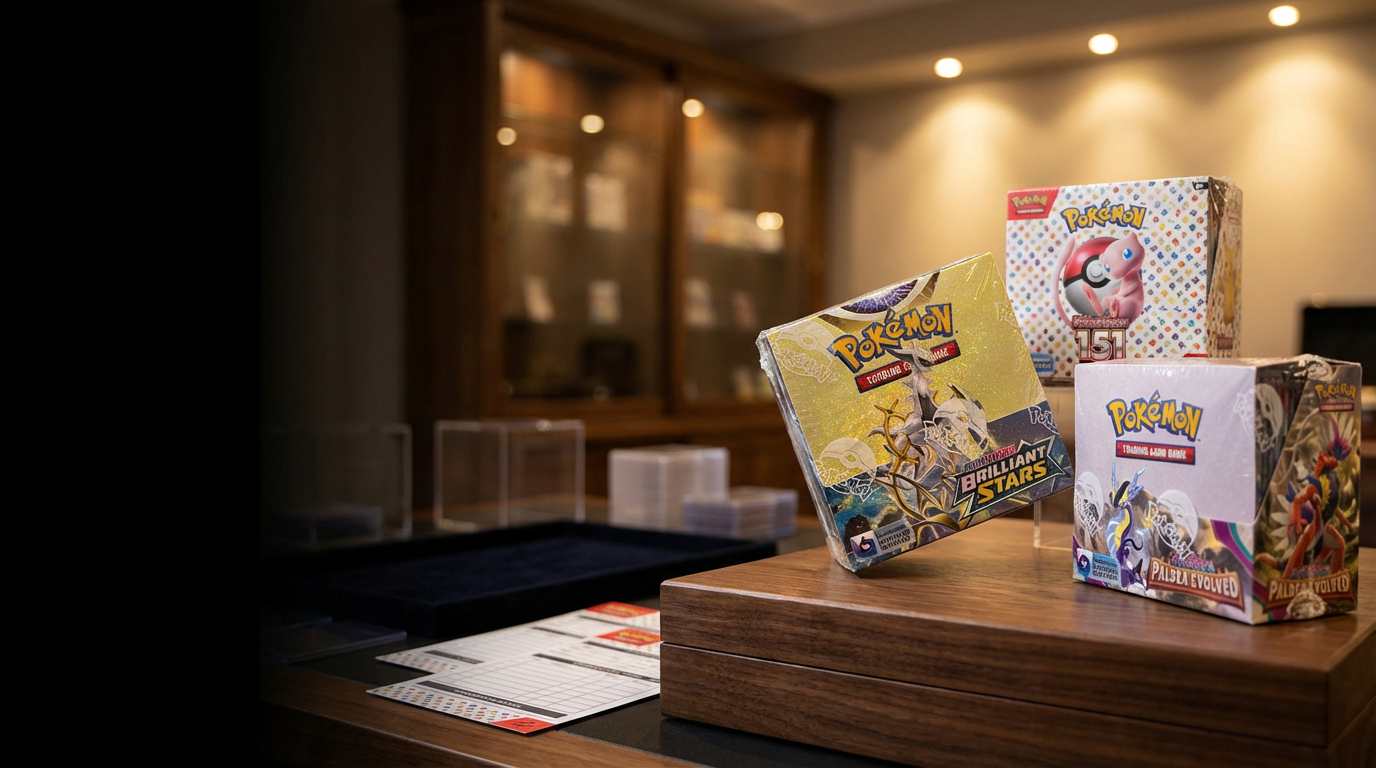
Best Pokemon Booster Boxes to Invest in 2026
The Pokemon TCG market is experiencing unprecedented momentum in 2026, with sealed products becoming increasingly attractive investment vehicles. Following Pokemon Day 2026 on February 27th and the upcoming Standard rotation on April 10th, savvy collectors and investors are positioning themselves to capitalize on market shifts. With vintage Pokemon cards having surged 6,208% since 2004 according to the Card Ladder index, the question isn't whether to invest in sealed Pokemon products—it's which booster boxes offer the best return potential.
This comprehensive guide examines the top Pokemon booster boxes for investment in 2026, analyzing market catalysts, rotation impacts, and strategic diversification approaches to help you make informed decisions in today's dynamic market.
Why 2026 Is a Critical Year for Pokemon Sealed Investments
The Perfect Storm of Market Catalysts
Several converging factors are creating exceptional opportunities in the sealed Pokemon market:
Pokemon's 30th Anniversary Hype: The franchise's milestone anniversary is driving nostalgia-fueled demand across all product categories, from vintage to modern releases.
Standard Rotation Impact: The April 10, 2026 rotation removing G-regulation sets (Scarlet & Violet Base, Paldea Evolved, Obsidian Flames, 151, Paradox Rift, and Paldean Fates) from competitive play creates artificial scarcity as players liquidate collections while collectors accumulate sealed product.
Mega Evolution Era Returns: New releases like Ascended Heroes (January 30) and Perfect Order (March 27) are rekindling interest in beloved mechanics, creating ripple effects across related vintage products.
Post-Pandemic Market Maturation: The market has stabilized from the 2020-2021 speculation bubble, with more sophisticated investors entering the space and driving sustainable growth in quality sealed products.
Understanding Booster Box Investment Fundamentals
Before diving into specific recommendations, it's essential to understand what makes a booster box investment-worthy:
- Chase Card Density: Sets with multiple high-value chase cards maintain stronger sealed product prices
- Print Run Scarcity: Limited print runs or discontinued sets appreciate faster
- Playability Factor: Sets with competitively viable cards see initial demand spikes, then appreciation after rotation
- Nostalgia Appeal: Sets featuring fan-favorite Pokemon or mechanics have longer-term collector demand
- Condition Sensitivity: Sealed products are less condition-dependent than singles, reducing risk
Top Pokemon Booster Boxes for Investment in 2026
1. Brilliant Stars (Sword & Shield Era)
Investment Grade: S-Tier
Brilliant Stars has emerged as one of the most recommended modern booster boxes for investment, and for good reason. This Sword & Shield set features the highly coveted Trainer Gallery subset, which fundamentally changed the value proposition of every pack.
Why Brilliant Stars Stands Out:
- Trainer Gallery Innovation: The special subset features alternate art versions of popular Pokemon and trainers, with every pack containing a reverse holo slot that can pull rare Trainer Gallery cards
- Chase Card Lineup: Charizard VSTAR, Arceus VSTAR, and multiple Trainer Gallery hits maintain strong individual values
- Pack-Opening Experience: The "every pack feels like a win" factor drives sustained opening demand, supporting sealed prices
- Sword & Shield Nostalgia: As the era moves further into the rearview mirror, sealed Sword & Shield products are appreciating steadily
Investment Considerations:
Brilliant Stars represents a balanced investment with moderate risk and solid upside potential. The print run was substantial, so this is a long-term hold (3-5 years minimum) rather than a quick flip. However, the consistent demand from both collectors and pack-opening enthusiasts provides price floor support.
2. Pokemon 151 (Scarlet & Violet Era)
Investment Grade: S-Tier
Pokemon 151 has already demonstrated explosive growth, with sealed ETBs reportedly surging 140% over two years and Mini Tin displays tripling to over $300. This set's focus on the original 151 Kanto Pokemon taps into the most powerful nostalgia driver in the franchise.
Key Investment Drivers:
- Universal Appeal: Original 151 Pokemon resonate with collectors across all age groups
- Master Set Completion Challenge: Collectors pursuing complete 151 sets drive sustained single and sealed demand
- Limited Availability: Shorter print window compared to main sets creates natural scarcity
- Rotation Catalyst: As a G-regulation set rotating April 10th, competitive players are liquidating while collectors accumulate
Market Performance:
The sealed product trajectory for Pokemon 151 has outpaced most modern sets, with mini tin displays showing particularly strong appreciation. Booster boxes, while having larger print runs, benefit from the set's collector-focused nature and rotation timing.
Risk Assessment:
The primary risk is that current prices already reflect significant appreciation. New investors should consider dollar-cost averaging or focusing on specific sealed products (ETBs, specialty items) rather than going all-in at current price points.
3. Paldea Evolved (Scarlet & Violet Era)
Investment Grade: A-Tier
Frequently cited as one of the best modern boxes for investment potential, Paldea Evolved combines strong chase cards with rotation timing and competitive playability.
Investment Highlights:
- Iono Full Art: One of the most sought-after trainer cards in recent memory
- Eeveelution Appeal: Multiple Eevee evolution cards drive collector interest
- Rotation Timing: G-regulation status means April 10th creates a natural demand inflection point
- Competitive Pedigree: Strong tournament presence throughout its Standard legality supports initial demand
Strategic Positioning:
Paldea Evolved represents a sweet spot for investors—it's recent enough to be readily available at reasonable prices, but old enough that print runs are concluding. The rotation catalyst provides a near-term price driver, while long-term appreciation comes from set quality and chase card appeal.
4. Paldean Fates (Scarlet & Violet Era)
Investment Grade: A-Tier
As a special subset-focused set similar to Hidden Fates and Shining Fates, Paldean Fates brings the proven "subset premium" model to the Scarlet & Violet era.
Why Paldean Fates Appeals to Investors:
- Shiny Pokemon Subset: Special shiny versions of popular Pokemon drive collector demand
- Limited Print Run: Special sets typically have shorter print windows than main series releases
- Proven Model: Previous subset-focused sets (Hidden Fates, Shining Fates) have shown strong long-term appreciation
- Rotation Scarcity: G-regulation status adds urgency for collectors to secure sealed product
Comparative Analysis:
While Paldean Fates may not reach Hidden Fates' legendary status, it follows a proven formula. The set's reception has been positive, with strong chase cards and an engaging opening experience that supports sustained demand.
5. Obsidian Flames (Scarlet & Violet Era)
Investment Grade: B-Tier
Obsidian Flames may not have the immediate name recognition of Pokemon 151 or the subset appeal of Paldean Fates, but it offers value-oriented investors an interesting opportunity.
Investment Case:
- Charizard Factor: Multiple Charizard cards including ex and illustration rare versions
- Rotation Play: G-regulation set benefiting from April 10th rotation dynamics
- Lower Entry Price: Currently more affordable than premium sets, offering better risk/reward for patient investors
- Solid Chase Card Lineup: Mew ex, Tyranitar ex, and Charizard variants maintain collector interest
Risk/Reward Profile:
Obsidian Flames is a higher-risk, higher-reward play. It lacks the immediate collector appeal of 151 or the proven subset model of Paldean Fates, but its lower current prices mean appreciation percentages could exceed premium sets if the market recognizes its value.
Investment Strategy: The Era Diversification Approach
Rather than concentrating capital in a single set, experienced investors recommend an era diversification strategy—selecting one iconic box from each of the last five eras.
Why Era Diversification Works
Risk Mitigation: Different eras respond to different market forces. Vintage appreciates on scarcity, modern on playability and rotation, and mid-era products balance both factors.
Nostalgia Cycles: As player demographics shift, different eras enter and exit peak nostalgia windows. Diversification ensures you're positioned for multiple demographic waves.
Print Run Variation: Older eras have smaller print runs (higher scarcity premium), while newer eras have larger runs (lower entry prices, longer appreciation timelines).
Sample Era Diversification Portfolio
- XY Era: Evolutions (nostalgia play on Base Set)
- Sun & Moon Era: Hidden Fates (subset premium model)
- Sword & Shield Era: Brilliant Stars (Trainer Gallery innovation)
- Early Scarlet & Violet: Pokemon 151 (original 151 appeal)
- Current Scarlet & Violet: Paldea Evolved or Paldean Fates (rotation catalyst)
This approach provides exposure to different price points, scarcity levels, and appreciation timelines, reducing single-set risk while maintaining upside across multiple market scenarios.
Sealed vs. Singles: The Investment Decision
A critical consideration for Pokemon investors is whether to focus on sealed products or individual graded singles.
Advantages of Sealed Booster Box Investment
Lower Condition Risk: Sealed products don't face the same condition sensitivity as singles. A booster box is either sealed or it isn't—there's no "PSA 7 vs. PSA 10" debate.
Broader Market Appeal: Sealed products appeal to investors, collectors, and pack-opening enthusiasts, creating multiple demand sources.
Storage Efficiency: Booster boxes are standardized sizes, making storage and inventory management simpler than managing diverse singles collections.
Liquidity: Popular sealed products often have more liquid markets than niche singles, especially at the booster box price point ($100-300).
When Singles Make More Sense
Capital Efficiency: High-grade chase cards from a set may appreciate faster than sealed boxes if you correctly identify winners.
Space Constraints: Graded singles require significantly less storage space than sealed boxes.
Targeted Exposure: If you believe specific cards will outperform their sets, singles allow precise positioning.
For most investors, a hybrid approach makes sense—core sealed holdings for stability, with selective singles positions for targeted upside.
Evaluating Booster Box ROI: Key Metrics
When assessing potential Pokemon booster box investments, consider these quantitative and qualitative factors:
Quantitative Metrics
Expected Value (EV): Compare the average value of pulls from a booster box to its current market price. You can analyze this using our EV Calculator to determine if a box is currently undervalued based on its contents. Boxes trading below their EV often face opening pressure (bearish for sealed), while boxes above EV suggest strong sealed demand (bullish).
Price Trajectory: Analyze 6-month and 12-month price trends. Steady appreciation suggests sustainable demand, while volatile prices indicate speculation.
Print Run Estimates: While exact numbers aren't public, relative print run sizes can be inferred from distribution breadth and availability duration.
Singles Performance: Track the performance of key chase cards. Strong singles prices support sealed product values.
Qualitative Factors
Set Reception: Community sentiment, content creator coverage, and collector enthusiasm provide forward-looking demand indicators.
Playability: Sets with competitive staples see initial demand spikes, then rotation-driven appreciation.
Nostalgia Potential: Does the set feature Pokemon or mechanics that will trigger nostalgia in 5-10 years?
Special Features: Subsets, alternate arts, and unique mechanics add collector appeal beyond base card values.
Common Booster Box Investment Mistakes to Avoid
Mistake #1: Chasing Recent Hype
The worst time to buy a booster box is often when everyone is talking about it. Recent hype typically means prices have already appreciated, leaving you buying at or near peak prices.
Better Approach: Identify quality sets trading near MSRP or slight premiums before hype cycles begin. This requires research and conviction, but yields better risk-adjusted returns.
Mistake #2: Ignoring Storage Costs
Booster boxes require climate-controlled storage to maintain condition. Humidity, temperature fluctuations, and sunlight exposure can damage sealed products.
Better Approach: Factor storage costs into ROI calculations. A $150 box appreciating to $300 over 5 years yields 14.9% annualized returns—but if storage costs $50/year, your actual return is negative.
Mistake #3: Over-Concentration
Putting all your capital into a single set or era creates unnecessary risk. Even "sure thing" sets can underperform due to reprints, market shifts, or changing collector preferences.
Better Approach: Use the era diversification strategy outlined above, spreading capital across multiple sets and time periods.
Mistake #4: Neglecting Liquidity
Some sealed products appreciate on paper but lack liquid markets when you're ready to sell. Obscure sets or foreign-language products may be difficult to move quickly.
Better Approach: Focus on English-language, mainstream sets with established market depth. Check completed sales data to ensure active markets exist.
Mistake #5: Emotional Attachment
Investing in your favorite childhood set sounds appealing, but emotional attachment clouds judgment and makes it harder to sell at optimal times.
Better Approach: Separate collection from investment. Keep a personal collection for enjoyment, but treat investment holdings as financial assets requiring objective analysis.
The Rotation Opportunity: April 10, 2026
The upcoming Standard rotation on April 10, 2026, represents one of the most significant near-term catalysts for G-regulation sealed products.
Understanding Rotation Dynamics
When sets rotate out of Standard format:
- Competitive players liquidate: Players sell rotating singles and sealed product to fund new deck builds
- Prices initially dip: Increased supply and decreased competitive demand create short-term price pressure
- Collectors accumulate: Savvy collectors and investors buy the dip, recognizing reduced future supply
- Appreciation begins: 6-12 months post-rotation, prices typically begin sustained appreciation as supply tightens
G-Regulation Sets Rotating April 10, 2026
- Scarlet & Violet Base
- Paldea Evolved
- Obsidian Flames
- Pokemon 151
- Paradox Rift
- Paldean Fates
Strategic Positioning
The optimal rotation investment strategy depends on your timeline:
Pre-Rotation (Now - April 9): Accumulate sealed product of strongest sets (Pokemon 151, Paldea Evolved, Paldean Fates) before rotation-driven scarcity becomes obvious.
Rotation Window (April 10 - May): Monitor for panic selling by competitive players. Quality sets may see temporary price dips creating buying opportunities.
Post-Rotation (June onwards): Prices typically stabilize and begin appreciation as the market recognizes reduced supply and sustained collector demand.
Long-Term vs. Short-Term Investment Horizons
Your investment timeline should influence which booster boxes you target.
Short-Term (1-2 Years)
Best Targets: Sets with near-term catalysts like rotation, anniversary releases, or competitive metagame shifts.
Recommended Boxes:
- Paldea Evolved (rotation catalyst)
- Paldean Fates (rotation + subset premium)
- Current releases with strong early reception
Risk Profile: Higher risk due to shorter appreciation timeline and greater exposure to market volatility.
Medium-Term (3-5 Years)
Best Targets: Quality modern sets with strong fundamentals but requiring time for scarcity premium to develop.
Recommended Boxes:
- Brilliant Stars (Trainer Gallery appeal)
- Pokemon 151 (nostalgia driver)
- Obsidian Flames (value play)
Risk Profile: Moderate risk with balanced appreciation potential as print runs conclude and collector demand strengthens.
Long-Term (5+ Years)
Best Targets: Sets likely to achieve iconic status, featuring beloved Pokemon, innovative mechanics, or cultural significance.
Recommended Boxes:
- Pokemon 151 (original 151 never goes out of style)
- Brilliant Stars (Trainer Gallery innovation)
- Hidden Fates (proven long-term performer from previous era)
Risk Profile: Lower risk due to longer timeline allowing multiple appreciation cycles and reduced sensitivity to short-term market fluctuations.
Market Outlook: What to Expect in 2026
Based on current trends and historical patterns, here's what the sealed Pokemon market likely holds for 2026:
Continued Vintage Appreciation
Vintage sealed products (Wizards of the Coast era, early EX series) will likely continue steady appreciation as supply diminishes and nostalgic millennials reach peak earning years.
Modern Market Maturation
The modern market (Sword & Shield, Scarlet & Violet) is maturing beyond the 2020-2021 speculation bubble. Expect more sustainable, fundamentals-driven appreciation rather than hype-fueled spikes.
Rotation-Driven Volatility
The April 10th rotation will create short-term volatility in G-regulation sealed products, with opportunities for patient investors willing to buy temporary dips.
30th Anniversary Effects
Pokemon's 30th anniversary will drive media coverage and mainstream attention, potentially bringing new collectors and investors into the market throughout 2026.
Print Run Speculation
As The Pokemon Company manages supply to balance accessibility with collectibility, speculation about print run sizes will continue influencing sealed product prices.
Practical Tips for Booster Box Investors
Authentication and Verification
Check Shrink Wrap: Authentic booster boxes have specific shrink wrap characteristics. Research set-specific details and compare to known authentic examples.
Buy from Reputable Sources: Established retailers, verified eBay sellers with strong feedback, and trusted community members reduce counterfeit risk.
Document Everything: Photograph purchases, save receipts, and maintain provenance documentation to support authenticity when selling.
Storage Best Practices
Climate Control: Store boxes in climate-controlled environments (65-70°F, 40-50% humidity).
Avoid Direct Sunlight: UV exposure fades packaging and damages shrink wrap.
Proper Stacking: Don't stack boxes more than 3-4 high to avoid crushing bottom boxes.
Protective Sleeves: Consider acrylic cases or protective sleeves for high-value boxes.
When to Sell
Knowing when to sell is as important as knowing what to buy:
Price Target Method: Set specific price targets based on ROI goals and sell when reached.
Time-Based Method: Commit to holding periods (3 years, 5 years) regardless of price fluctuations.
Market Signal Method: Monitor market indicators (singles prices, sealed availability, community sentiment) and sell when multiple signals suggest peak pricing.
Portfolio Rebalancing: Periodically sell appreciated holdings to lock in gains and redeploy capital to newer opportunities.
Building Your Booster Box Investment Portfolio
Here's a framework for building a diversified Pokemon booster box investment portfolio based on different budget levels:
Starter Portfolio ($500-1,000)
- 2x Paldea Evolved booster boxes ($200-250 each)
- 1x Obsidian Flames booster box ($150-180)
- 1x Current release with strong reception ($100-150)
Strategy: Focus on recent releases with rotation catalysts and strong fundamentals. Lower entry prices allow diversification even with limited capital.
Intermediate Portfolio ($2,000-5,000)
- 2x Pokemon 151 booster boxes ($400-500 each)
- 2x Brilliant Stars booster boxes ($300-400 each)
- 2x Paldea Evolved booster boxes ($200-250 each)
- 1x Paldean Fates booster box ($200-250)
- 1x Hidden Fates (previous era) ($400-500)
Strategy: Era diversification with emphasis on proven performers and rotation-catalyst sets. Mix of short and medium-term holdings.
Advanced Portfolio ($10,000+)
- 3x Pokemon 151 booster boxes ($400-500 each)
- 3x Brilliant Stars booster boxes ($300-400 each)
- 2x Paldea Evolved booster boxes ($200-250 each)
- 2x Paldean Fates booster boxes ($200-250 each)
- 2x Hidden Fates booster boxes ($400-500 each)
- 1x Evolutions booster box ($800-1,000)
- 1x Vintage sealed product (budget dependent)
- Reserve capital for rotation-window opportunities
Strategy: Full era diversification with multiple units of strongest sets. Includes vintage exposure and capital reserves for opportunistic buying.
Final Thoughts: The Long Game
Successful Pokemon booster box investing requires patience, research, and disciplined execution. The sets highlighted in this guide—Brilliant Stars, Pokemon 151, Paldea Evolved, Paldean Fates, and Obsidian Flames—represent strong fundamentals-based opportunities in 2026, but they're not get-rich-quick schemes.
The Pokemon TCG has demonstrated 20+ years of sustained collector interest, with sealed product appreciation driven by genuine scarcity, nostalgia cycles, and expanding collector demographics. While past performance doesn't guarantee future results, the fundamentals supporting sealed Pokemon investments remain strong.
Whether you're a seasoned investor expanding into alternative assets or a collector looking to make your hobby pay for itself, booster boxes offer an accessible entry point to Pokemon TCG investing. Start with quality sets, diversify across eras, store properly, and maintain a long-term perspective.
The April 10, 2026 rotation creates near-term opportunities in G-regulation sets, while Pokemon's 30th anniversary drives broader market momentum. By combining strategic timing with fundamentals-based selection, 2026 presents exceptional opportunities for patient, informed booster box investors.
Note: Past performance does not guarantee future results. Always do your own research before making investment decisions. The Pokemon TCG market can be volatile, and sealed product values may decrease as well as increase. Only invest capital you can afford to have tied up for extended periods.
Pokemon Price Tracker
Market Analyst
Related Articles
Prismatic Evolutions Price Guide: 2026 Market Update
A comprehensive 2026 price guide for Pokemon Prismatic Evolutions covering the Umbreon ex SIR, Sylveon ex, Master Ball reverse holos, sealed ETBs, and Super Premium Collection. Get current market values, grading insights, and set completion costs.
Pokemon Price Tracker
Best Pokemon Booster Boxes to Buy and Hold in 2026
From Evolving Skies to Japanese Pokemon 151, discover the best Pokemon booster boxes to buy and hold in 2026. Data-driven picks, portfolio strategy, and key metrics to watch for long-term sealed investors.
Pokemon Price Tracker
Japanese vs English Pokemon Cards: Which Holds Value in 2026?
The Japanese vs English Pokemon card debate has fundamentally shifted in 2026. Japanese PSA 10s now command 20-40% premiums over English equivalents, while raw English cards still cost 2x-6x more. Here's how to navigate both markets strategically.
Pokemon Price Tracker
Stay Updated
Subscribe to our newsletter for the latest Pokemon card market trends, investment opportunities, and exclusive insights delivered straight to your inbox.