The Pokemon card grading landscape has shifted dramatically in 2026. With the graded Pokemon card market now valued at approximately $10 billion, choosing the right grading company has never carried higher financial stakes. PSA remains the dominant force with roughly 72% market share, but a crippling backlog crisis has forced the company to pause its most popular submission tiers — opening a massive door for CGC, which is now growing at a staggering 121% year-over-year.
So should you send your cards to PSA and wait, pivot to CGC for faster turnarounds, or split your submissions strategically? This comprehensive 2026 breakdown compares pricing, turnaround times, resale value, and real-world ROI so you can make the smartest decision for your collection.
Before diving into head-to-head comparisons, it's crucial to understand how we got here. The grading industry entered 2026 riding a wave of record-breaking submissions driven by the Scarlet & Violet era, Japanese card popularity, and the explosive resurgence of vintage WOTC cards.
Market Share Breakdown (2026)
- PSA: ~72% market share — still the gold standard for resale value
- CGC: ~18% market share — growing 121% YoY
- TAG, BGS, and others: ~10% combined
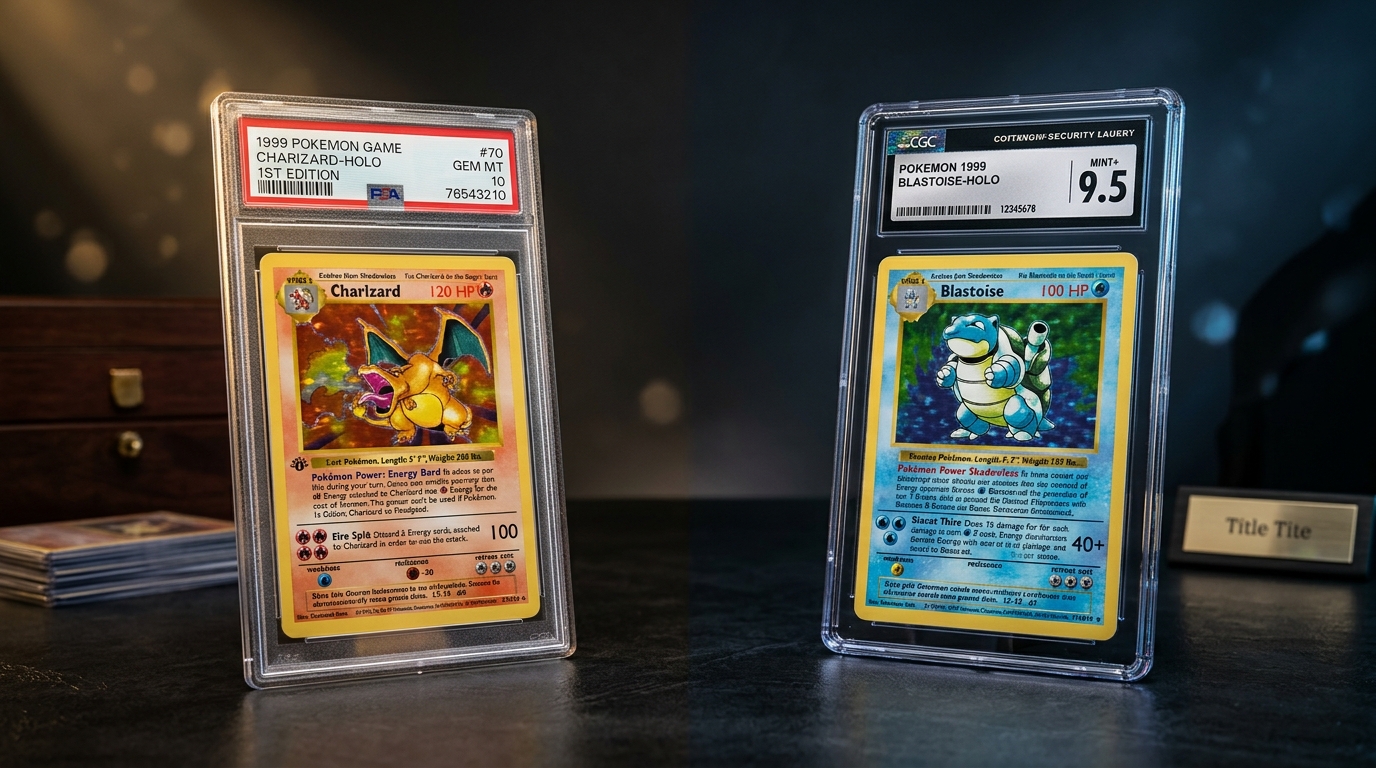
A PSA 10 Pokemon card typically sells for 10-30% more than a CGC 10 equivalent, and 20-40% more than a TAG 10. That premium is the single biggest reason PSA retains its stranglehold — but it comes with a massive catch in 2026: you might not be able to submit to PSA at all.
The biggest grading story of 2026 is PSA's unprecedented operational crisis.
Timeline of the Crisis
- June 2, 2026: PSA temporarily paused new submissions for all four Value service tiers (Value Bulk, Value, Value Plus, Value Max) after a 20% submission spike added 1.6 million cards to an already-strained backlog approaching 10 million.
- June 15, 2026: The pre-pause rush pushed the active backlog from 10 million to a staggering 14 million cards.
- September 14, 2026: PSA launched a new Standard tier at $59.99 to restore a sub-$80 option for budget submitters.
- October 6, 2026: Active backlog reduced to 8.2 million units — but Value tiers remain paused with no reopening date announced.
For collectors used to paying $20-25 to grade bulk cards through PSA Value, this has been nothing short of a seismic shift. The cheapest PSA option in 2026 is now nearly triple what Value tier submitters paid in previous years.
Here's a direct side-by-side look at current submission costs and turnaround times as of October 2026.
PSA Tiers (Open as of October 2026)
| Tier | Price | Turnaround |
|---|
| Standard (new) | $59.99 | 90-100 business days |
| Priority (formerly Regular) | $79.99 | 70-80 business days |
| Express | $199 | 20-30 business days |
| Super Express | $349 | 10-15 business days |
| Premier (formerly Walk-Through) | $599 | 7-10 business days |
Paused Tiers: Value Bulk, Value, Value Plus, Value Max
CGC Tiers (All Open)
| Tier | Price | Turnaround |
|---|
| Bulk | $17 | 120 working days (25-card minimum) |
| Standard | $55 | 10 working days |
| Express | $100 | 5 working days |
The Critical Takeaway
CGC is currently the only major grading service with its full ladder open. That operational reality alone reshapes the entire comparison. If you want to grade bulk-value cards in 2026 and don't want to wait on PSA's indefinite Value tier pause, CGC's $17 bulk tier is essentially the only game in town among top-tier graders.
This is where the comparison gets nuanced. PSA 10s consistently outsell CGC Pristine 10s and CGC 10s on the open market, but the gap varies significantly based on card type, era, and buyer demographics.
Typical Resale Premiums (2026 Data)
- Modern English Pokemon (Scarlet & Violet era): PSA 10 commands a 10-20% premium over CGC Pristine 10
- Vintage WOTC (Base Set, Jungle, Fossil): PSA 10 premium can reach 30-50%+
- Japanese Pokemon cards: Gap narrows to 5-15% — CGC is more widely accepted in Japanese collector communities
- High-end chase cards ($1,000+): PSA 10 premium typically 20-30%
CGC Pristine 10 vs CGC 10 vs PSA 10
CGC uses a more granular grading scale. A CGC Pristine 10 (perfect 10 across all four subgrades) is rarer than a standard CGC 10 and often sells closer to — or occasionally matching — PSA 10 prices on the same card. If you can land a Pristine 10, the resale penalty shrinks dramatically.
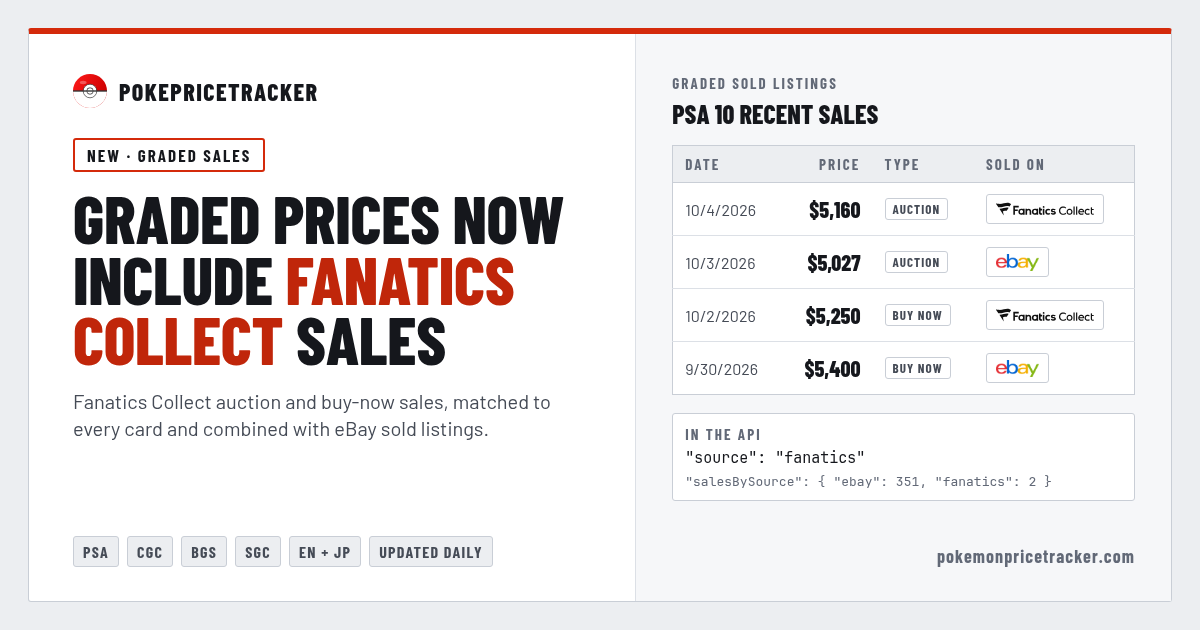
To see current market spreads for your specific card, you can check price history on Pokemon Price Tracker and compare PSA vs CGC sold listings side by side.
Sticker price isn't the full picture. Here's what you're actually paying when you factor in shipping, insurance, and opportunity cost.
Real Cost Example: Grading a $200 Modern Card
PSA Priority ($79.99)
- Grading fee: $79.99
- Shipping to PSA (insured): ~$15
- Return shipping (included for most tiers)
- Total out-of-pocket: ~$95
- Wait time: 70-80 business days (14-16 weeks)
CGC Standard ($55)
- Grading fee: $55
- Shipping to CGC (insured): ~$12
- Return shipping: varies
- Total out-of-pocket: ~$67-75
- Wait time: 10 working days (2 weeks)
The ROI Math
If your raw $200 card grades a 10:
- PSA 10 estimated value: $450
- CGC 10 estimated value: $380
After grading costs:
- PSA profit: ~$355
- CGC profit: ~$305
PSA wins the raw dollar comparison by $50 — but CGC returns your card 60+ business days faster, letting you flip, reinvest, or compound capital much more quickly. For high-volume submitters, that time savings often outweighs the per-card premium.
Before sending any card in, run the numbers using the Grading ROI Calculator to see whether grading is actually worth it for your specific card and condition.
PSA still makes sense in several specific scenarios:
1. High-Value Vintage Cards
If you're grading a WOTC Charizard, Base Set holo, or Trophy card worth $500+, the PSA 10 premium (often 30-50%) more than justifies the Priority or Express fee. The resale ceiling on PSA-graded vintage is simply unmatched.
2. You Need Maximum Resale Liquidity
PSA-graded cards sell faster on eBay, TCGPlayer, and in person. If you're planning to flip quickly, PSA's brand recognition shortens your time-to-sale.
3. Chase Cards for Long-Term Hold
For marquee pulls like Moonbreon, Umbreon VMAX Alt Art, or Japanese Special Art Rares, PSA 10 pop reports and historical sold data dominate collector reference points.
4. You Can Afford to Wait
If you don't need the cards back for 3-6+ months and can afford the $79.99+ Priority fee, PSA remains the resale value king.
CGC is often the smarter play in these situations:
1. Bulk Grading
With PSA's Value tiers paused indefinitely, CGC's $17 Bulk tier (25-card minimum) is the only cost-effective way to grade large quantities. For modern bulk cards worth $20-80 each, the math heavily favors CGC.
2. Fast Turnaround Needs
CGC Express returns cards in 5 working days. If you need to grade and flip around a specific market window (new set release, anniversary, meta shift), CGC is unbeatable.
3. Japanese Cards
The PSA/CGC resale gap narrows significantly on Japanese cards. CGC's cleaner slab design is actually preferred by many Japanese collectors, and with CGC's faster turnaround, it's often the superior choice.
4. Mid-Value Modern Cards ($50-200)
For cards in this range, the PSA 10 premium often doesn't justify the extra wait and higher cost. CGC's speed and open submission ladder make it the practical winner.
5. Pristine 10 Hunts
If your raw card has flawless centering, corners, edges, and surface, chasing a CGC Pristine 10 can yield near-PSA 10 money with faster service.
Let's zoom in on CGC's bulk pricing since it's the most compelling value proposition in the entire grading industry right now.
CGC Bulk Breakdown
- Cost: $17 per card
- Minimum: 25 cards per submission
- Minimum submission cost: $425
- Turnaround: 120 working days (~6 months)
For a 25-card bulk submission, you're paying $425 in grading fees plus roughly $25-40 in shipping and insurance. If even 10 of those cards grade 10s and are worth $75+ each graded, you've already covered your submission cost — anything beyond that is pure profit.
Use this quick-reference flowchart to decide where to send your cards:
- Card worth under $30 raw? → Don't grade, or wait for PSA Value to reopen.
- Card worth $30-100 raw and modern? → CGC Standard or Bulk.
- Card worth $100-300 raw? → Run the numbers on both. CGC often wins on time-adjusted ROI.
- Card worth $300-1,000 raw? → PSA Priority is usually worth the wait.
- Card worth $1,000+? → PSA Express or Super Express — maximize resale and get it back faster.
- Japanese card? → CGC in most cases.
- Bulk submission (25+ cards)? → CGC Bulk is the only viable option in 2026.
Risks and Considerations
No grading decision is risk-free. Here are the key factors to weigh:
PSA Risks
- Backlog uncertainty: No guarantee Value tiers reopen in 2026
- Price increases: PSA has raised prices multiple times recently
- Longer capital lockup: 70-100+ business days on open tiers
CGC Risks
- Lower resale ceiling: 10-30% discount on most cards vs PSA 10
- Perception gap: Some vintage collectors still refuse non-PSA slabs
- Grading consistency debates: CGC has faced criticism for perceived grade inflation in some communities
Note: Past performance does not guarantee future results. Always do your own research before making investment decisions.
There's no universal winner — but there is a clear framework:
- PSA wins on resale value, especially for vintage and high-end chase cards.
- CGC wins on availability, speed, and bulk economics — and in 2026, that's arguably more valuable than ever.
- The smartest submitters are splitting their strategy: PSA for high-value cards they can afford to wait on, CGC for everything else.
The days of defaulting every submission to PSA are over. With Value tiers paused and backlogs still at 8+ million cards, CGC has earned a legitimate seat at the table for a huge chunk of the market. The 121% YoY growth isn't hype — it's collectors making rational decisions based on 2026 realities.
- PSA retains its ~72% market share and 10-30% resale premium on most cards
- CGC's full submission ladder is open; PSA's Value tiers remain paused as of October 2026
- PSA's new Standard tier ($59.99) is the cheapest open PSA option — but still over 3x CGC Bulk
- CGC Bulk at $17/card is unmatched for high-volume submitters
- Japanese cards and mid-value modern cards favor CGC in 2026
- High-end vintage and chase cards still favor PSA
- Always calculate ROI before submitting — raw card value, grading cost, and estimated graded value all matter
The grading landscape will keep evolving, especially as PSA works through its backlog. For now, the best collectors and investors are the ones adapting fastest — and in 2026, that means seriously considering CGC for a larger slice of their submissions than ever before.
Note: Past performance does not guarantee future results. Always do your own research before making investment decisions.