The Pokemon card grading landscape has undergone a seismic shift in 2026. With PSA pausing its Value tier submissions, CGC aggressively expanding its market share, and the graded Pokemon card market ballooning into a $10 billion industry, collectors are asking a critical question: which grading company holds value best right now?
Whether you're sitting on a stack of vintage holos, chasing modern chase cards, or trying to decide where to send your next submission, choosing between CGC and PSA in 2026 is more consequential than ever. This deep dive breaks down pricing, turnaround times, resale premiums, and the real-world data behind each grader's market position.
Before we compare graders, let's set the stage. The graded card industry has never been bigger or more competitive:
- $10 billion market cap: The graded Pokemon card segment officially crossed the $10 billion threshold in 2026
- 94% of collectors own at least one graded card
- 97 of the top 100 graded cards across all major graders in 2025 were Pokemon
- TCG cards have officially surpassed sports cards in total submission volume
- PSA is on pace for 20+ million graded cards in 2026, up 39% year-over-year from January through April
This explosive growth has strained PSA's infrastructure and created a rare opening for competitors like CGC and Beckett to capture new market share.
On June 2, 2026, PSA made a decision that reshaped the grading industry overnight: it suspended its Value tier submissions to work through a staggering backlog of more than 10 million cards. The pause will remain in effect until PSA cuts that backlog in half to 5 million.
What This Means for Collectors
The Value Bulk tier was PSA's most popular entry point, priced at $24.99 per card for Collectors Club members. With that tier gone, the cheapest PSA option is now Regular service at $79.99 per card — more than triple the previous cost.
For collectors grading modern cards worth $50–$200 raw, the math has completely changed. A card that would have generated healthy ROI at $24.99 grading cost may now be a break-even (or loss-making) submission at $79.99.
PSA's Market Share Is Shifting
The fallout is measurable. According to GemRate data:
- Early 2026: PSA held 75–76% market share of graded Pokemon cards
- June–July 2026: PSA's share dropped to 69%
- PSA's monthly capacity: Roughly 2.4–2.5 million cards per month, essentially maxed out
- CGC's sports card growth: A staggering 311% year-over-year increase
That 6-7 point drop in market share isn't going nowhere — it's being absorbed primarily by CGC and, to a lesser extent, Beckett. This is the biggest disruption PSA has faced in over a decade.
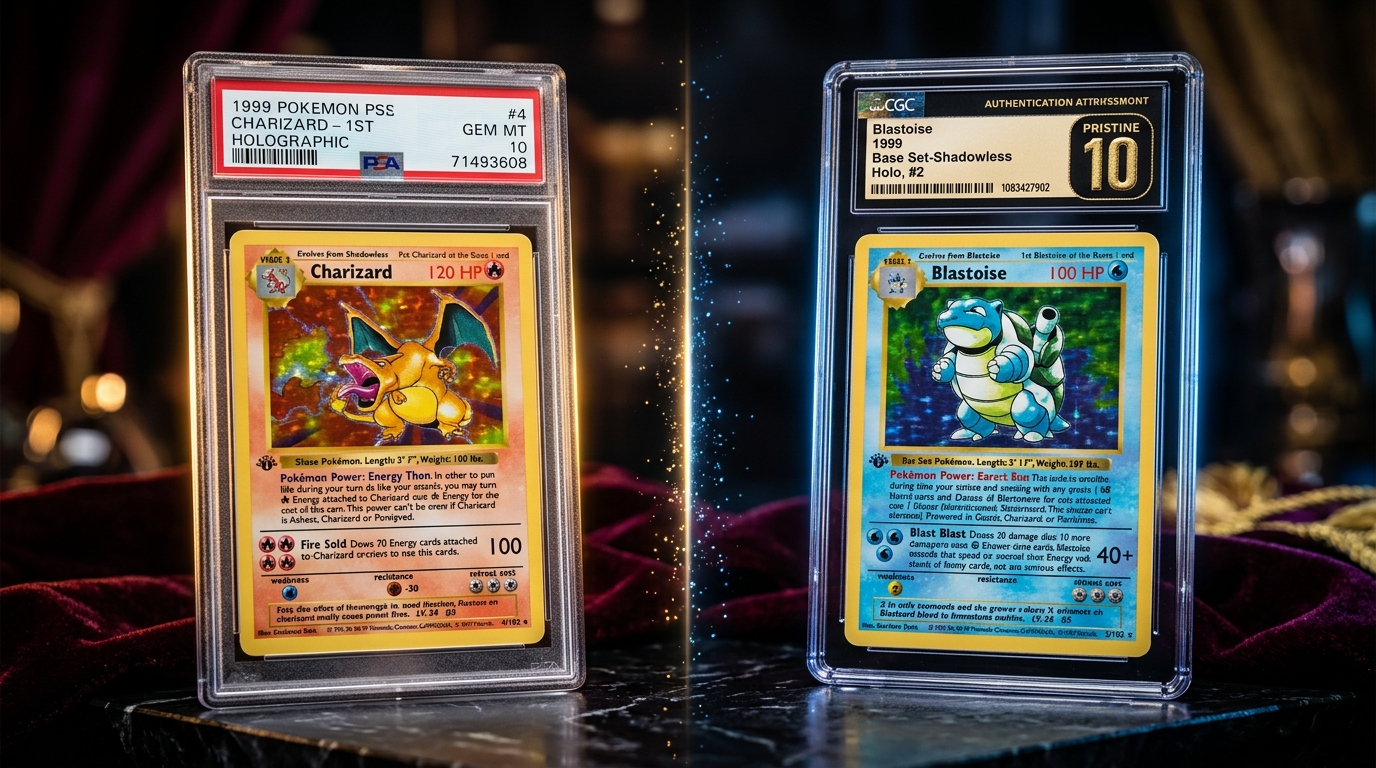
Despite the operational chaos, PSA remains the gold standard when it comes to resale value. A PSA 10 typically commands a significant premium over the equivalent CGC 10 (or CGC Pristine 10) — but that gap is narrowing.
PSA Pricing Breakdown (2026)
| Service Tier | Price per Card | Turnaround | Max Value |
|---|
| Value (PAUSED) | $24.99 | 65 business days | $499 |
| Regular | $79.99 | 45 business days | $1,499 |
| Express | $149 | 20 business days | $2,499 |
| Super Express | $299 | 10 business days | $4,999 |
| Walk-Through | $600+ | 5 business days | $9,999+ |
PSA Pros in 2026
- Highest resale premiums across almost every major Pokemon card
- Deepest population data — buyers trust PSA pop reports the most
- Strongest brand recognition among casual buyers and investors
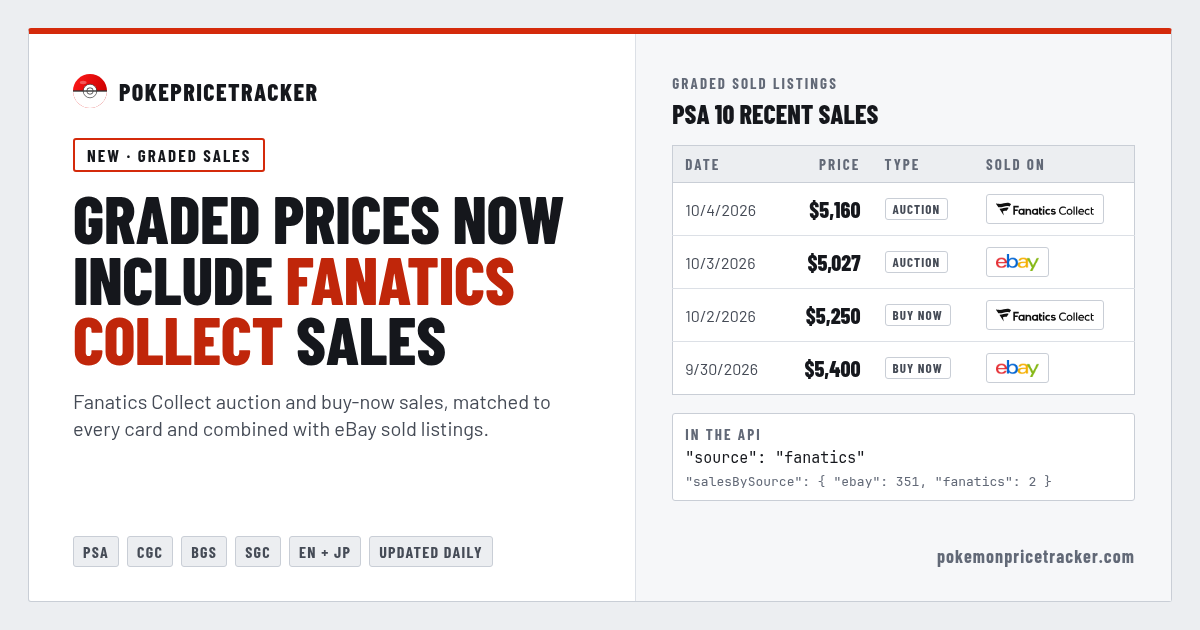
- Best liquidity — PSA 10s sell faster on eBay, TCGPlayer, and Fanatics Collect
PSA Cons in 2026
- No affordable bulk option — pricing starts at $79.99
- Backlogs stretching 60–90+ business days on cheaper tiers
- Grading inconsistency complaints have grown as volume exploded
- Higher barrier to entry for casual submitters
CGC has spent the last few years positioning itself as a legitimate PSA alternative, and 2026 is the year that positioning is paying off. With sharper turnaround times, aggressive bulk pricing, and the reputation-boosting CGC Pristine 10 grade, CGC is winning over collectors PSA can no longer serve.
CGC Pricing Breakdown (2026)
| Service Tier | Price per Card | Turnaround |
|---|
| Bulk (100+ cards) | $12–$18 | 40–60 business days |
| Standard | $25 | 30 business days |
| Express | $50 | 10 business days |
| Walk-Through | $150+ | 5 business days |
CGC's bulk pricing is now roughly half of what PSA's cheapest tier costs, making it the default choice for volume submitters and collectors grading mid-value cards.
The CGC Pristine 10 Advantage
One of CGC's key differentiators is the Pristine 10 grade — a perfect-in-every-subgrade designation that's rarer and more prestigious than a standard CGC 10. On the secondary market:
- CGC Pristine 10s frequently sell for 1.5x–3x the price of a standard CGC 10
- On some modern chase cards, a Pristine 10 approaches or matches PSA 10 pricing
- Population reports show Pristine 10s are meaningfully rarer than PSA 10s on most modern sets
This has created a genuine two-tier system within CGC that gives high-quality submissions a chance to command PSA-level prices.
CGC Pros in 2026
- Significantly cheaper across every tier
- Faster turnaround — especially on bulk submissions
- Pristine 10 designation commands premium pricing
- Cleaner, more modern slab design favored by many collectors
- Subgrades included by default at no extra cost
CGC Cons in 2026
- Lower resale value on most cards vs. PSA equivalents
- Smaller buyer base — sales can take longer
- Perceived (fairly or not) as stricter on modern centering
- Less recognition among casual collectors and investors
This is where theory meets reality. Let's look at how much of a premium PSA 10s actually command over CGC 10s on popular 2026 cards. These are directional market observations, not guarantees.
Modern Chase Cards (Scarlet & Violet era)
- PSA 10 premium over CGC 10: Typically 25–60%
- PSA 10 premium over CGC Pristine 10: Often only 10–25%
Vintage WOTC (Base Set, Jungle, Fossil)
- PSA 10 premium over CGC 10: Frequently 50–100%+
- Vintage collectors overwhelmingly prefer PSA — the gap here is the widest
Japanese Cards
- CGC has gained meaningful ground in the Japanese card market
- Some Japanese sets show only a 10–20% PSA premium, and a few actually favor CGC
- Check current Japanese card prices for real-time comparisons
Modern Bulk Cards ($20–$100 raw)
- The economics have flipped entirely in 2026
- With PSA Value tier gone, CGC bulk is often the only profitable option
- A CGC 10 selling for $80 with $15 grading cost beats waiting 90+ days for a PSA 10 at $79.99 grading cost
The right answer depends entirely on what you're grading and your goals. Here's a practical decision framework:
Choose PSA If:
- You're grading vintage cards (WOTC through EX era)
- Your card is worth $500+ raw — the PSA 10 premium justifies the cost
- You need maximum liquidity and fastest sale time
- You're grading a major chase card where the PSA premium is 40%+
- You have the patience to wait 45–90+ business days
Choose CGC If:
- You're grading modern cards worth $50–$300 raw
- You want to submit in bulk and value cost efficiency
- You're chasing a Pristine 10 on a pristine copy
- You need faster turnaround than PSA can currently offer
- You're grading Japanese cards where the PSA premium is narrower
- You're a new submitter testing the waters without a huge investment
Choose Neither (Stay Raw) If:
- The card is worth under $30 raw and the grading cost exceeds potential upside
- Centering, edges, or surface issues make a 10 unlikely
- You're planning to hold long-term and don't need the slab for storage or display
Before submitting anything in 2026, run the math. The PSA pause has made bulk grading calculations more complex, and the CGC vs PSA decision now depends on more variables than ever — grade probability, tier pricing, and current market spreads.
Our Grading ROI Calculator lets you plug in raw card value, expected grade distribution, grading tier costs, and current PSA vs CGC market prices to see which route delivers the best expected return.
You can also cross-reference population data to see how rare a PSA 10 vs. CGC Pristine 10 actually is for your specific card — a critical factor that affects future resale premiums.
For collectors submitting 50+ cards at a time, 2026 has reshaped the strategy entirely.
Before June 2026 (PSA Value Era)
- PSA bulk at $24.99 was the clear winner for most modern cards
- CGC was a value play primarily on borderline-grade cards or for faster turnaround
After June 2026 (Post-Pause Era)
- CGC bulk at $12–$18 is now the default choice for cost-conscious submitters
- PSA Regular at $79.99 only makes sense on cards worth $200+ raw
- Beckett has re-entered the conversation on select premium cards
- Hybrid strategies — sending high-value cards to PSA and modern bulk to CGC — are now the norm
Here's the honest answer: probably not fully, but the gap will keep narrowing.
PSA's brand equity was built over three decades and won't erode quickly, even with operational stumbles. Vintage collectors — the segment with the deepest pockets — remain overwhelmingly loyal to PSA.
However, several trends favor CGC's continued growth:
- Younger collectors are more agnostic about grader brand and more price-sensitive
- Modern card volume (where CGC is most competitive) is the fastest-growing segment
- PSA's operational challenges may persist even after the Value pause ends
- Pristine 10 recognition continues to grow, especially on modern chase cards
- CGC's marketing and social media presence is aggressively targeting Pokemon collectors
If PSA reopens Value tier submissions at a higher price point (say, $39.99–$49.99), CGC's structural cost advantage will still hold on bulk submissions.
- PSA still holds the highest resale premium, especially on vintage cards, but the gap is narrowing on modern cards and Japanese cards.
- PSA's Value tier pause (June 2026) has fundamentally changed bulk grading economics — CGC is now the default for cost-conscious submitters.
- CGC Pristine 10s approach PSA 10 pricing on many modern cards, making CGC a legitimate choice for pristine copies.
- Market share is shifting: PSA dropped from 76% to 69% in 2026, with CGC absorbing most of that demand.
- A hybrid strategy — PSA for premium/vintage cards, CGC for modern bulk — is the smart play for 2026.
- Always run the numbers with a grading calculator before submitting anything.
The smartest collectors in 2026 aren't picking a side in the CGC vs PSA debate — they're using both strategically, based on the specific card, its value, and current market spreads. Track your submissions, monitor pricing trends, and adjust as the landscape continues to evolve.
Note: Past performance does not guarantee future results. Grading premiums, turnaround times, and market shares change frequently. Always do your own research and check current pricing data before making grading or investment decisions.