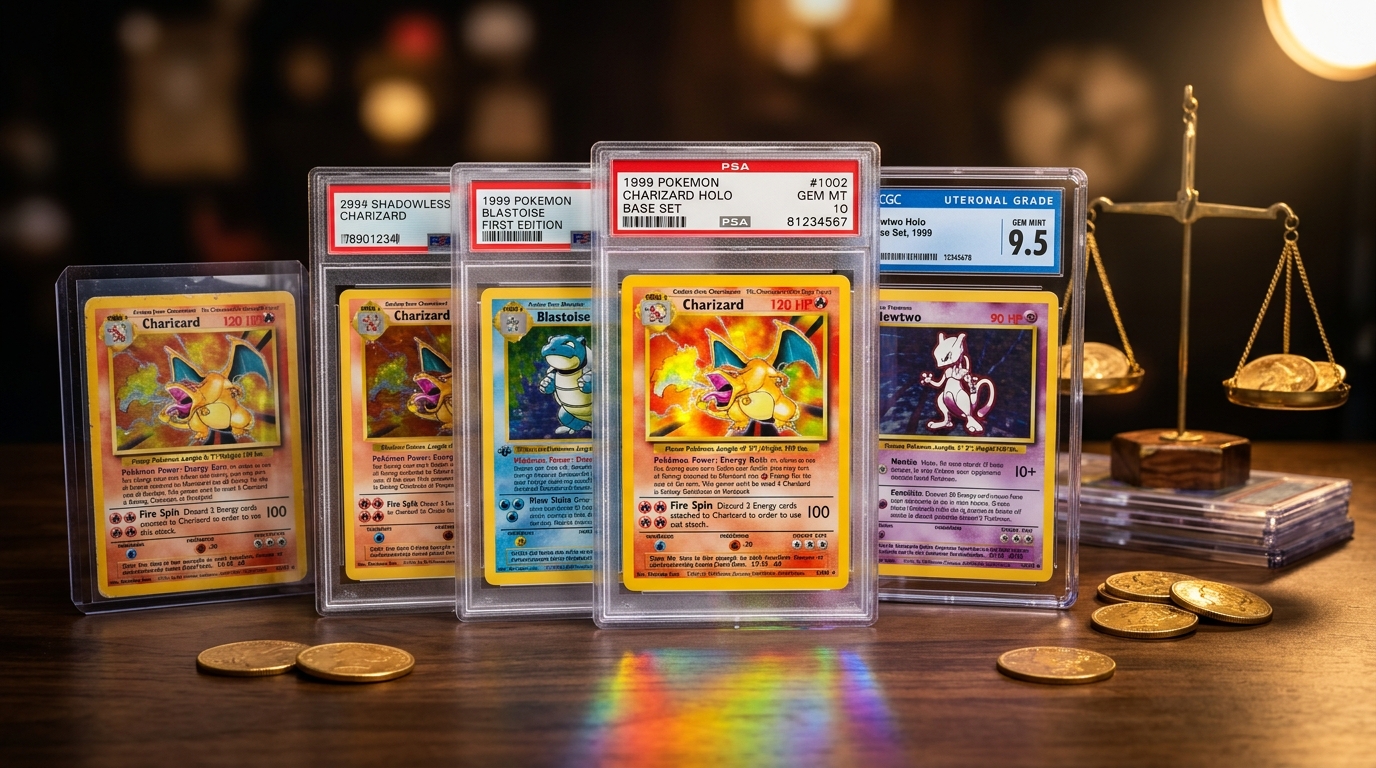
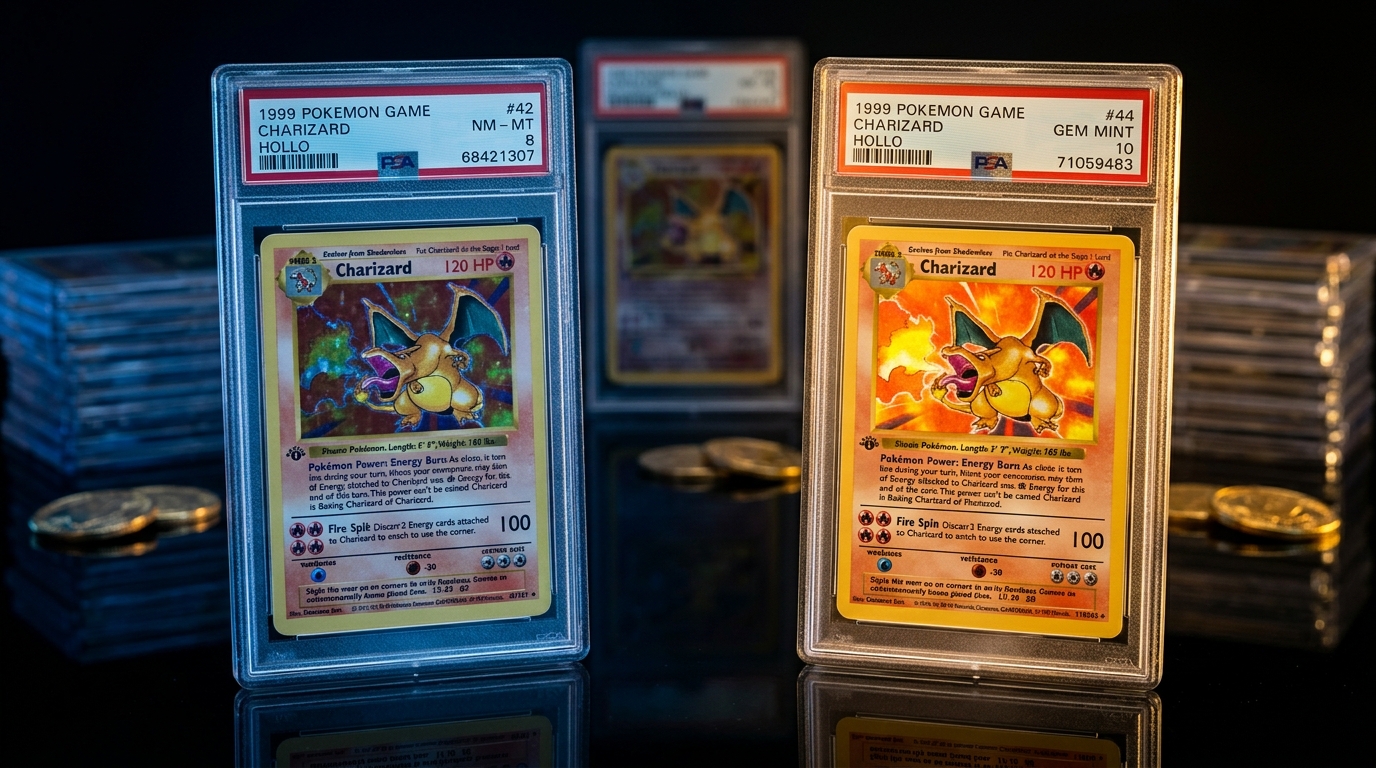
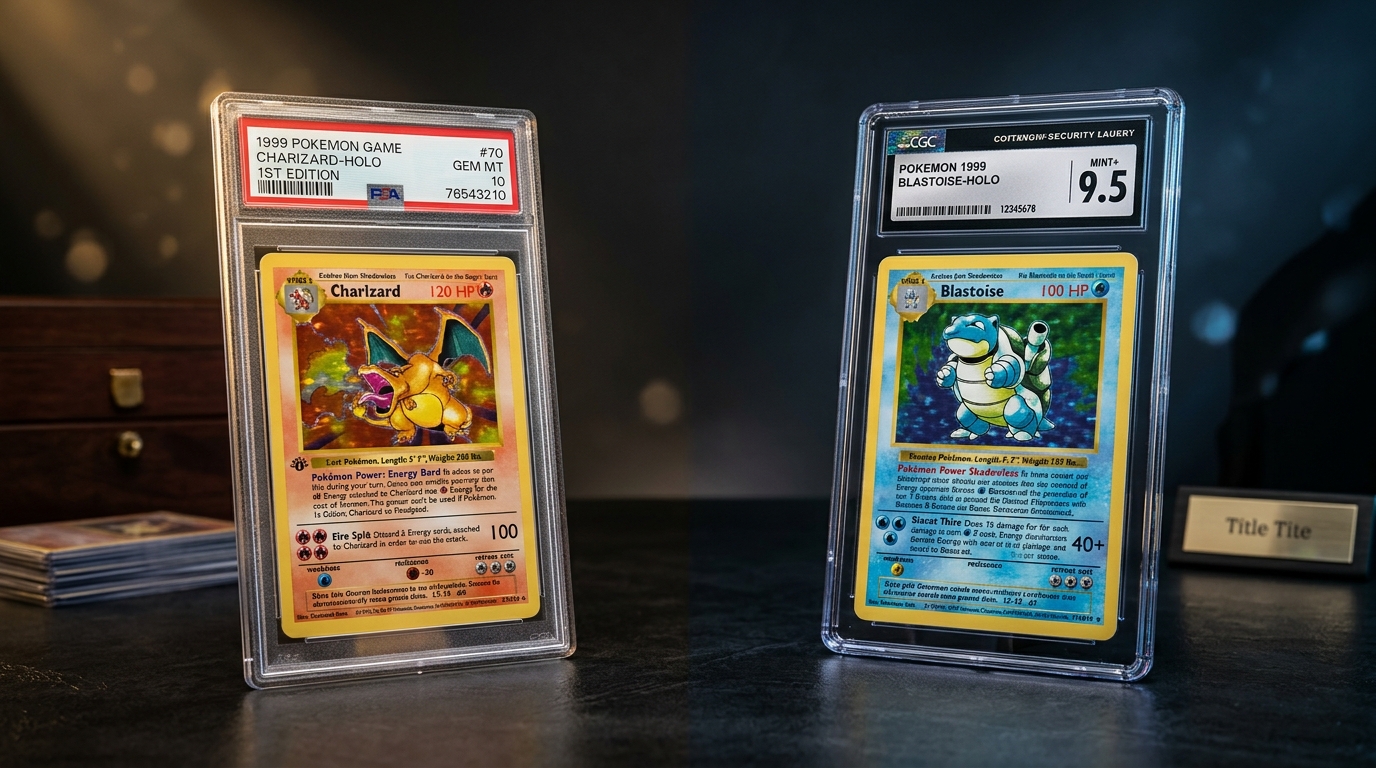
Grading a Pokemon card used to be a straightforward math problem: pay $20, wait a few months, and if your raw card jumped a few tiers in value after a PSA 10, you made money. In 2026, that math has been completely rewritten.
With PSA's cheapest tier now at $59.99, a massive backlog that peaked at 12.4 million cards, and CGC aggressively undercutting the market at $15 per card in bulk, the grading ROI calculation has never been more complicated — or more important to get right before you ship cards off.
This guide breaks down exactly when grading is worth it in 2026, the true all-in cost per card across PSA, CGC, BGS, and SGC, and the break-even thresholds you need to hit before a submission makes financial sense.
The 2026 Grading Landscape: What Changed
The Pokemon TCG market is in the middle of a historic bull run. The 30th anniversary celebration pushed sales to record highs, including the $16.49 million Pikachu Illustrator sale that reshaped the top of the hobby. Since 2004, the Pokemon card market has grown approximately 3,821% — crushing the S&P 500's 483% growth over the same period.
That demand created a grading bottleneck no one fully anticipated.
The PSA Pricing Crisis
Here's the timeline that reshaped grading economics in 2026:
- May 28, 2026: PSA announces it will pause its Value Bulk, Value, Value Plus, and Value Max tiers to work through a backlog approaching 10 million cards.
- June 2, 2026: The four lowest-cost PSA tiers officially pause for new submissions.
- Late July 2026: The backlog peaks at roughly 12.4 million units.
- Mid-August 2026: Backlog slowly declines to around 11.85 million.
- October 20, 2026: Backlog down to 7.2 million items.
- October 29, 2026: PSA reopens the Value service — but at a new starting price of $59.99 for cards up to $1,000.
For five months, collectors who wanted cards graded quickly were funneled into PSA's Regular tier at $79.99 per card or forced to look elsewhere. Many did. CGC captured enormous market share during this window, and the grading-ROI conversation shifted from "PSA or nothing" to a genuine multi-grader decision.
The advertised grading fee is only part of the story. When calculating ROI, you need to factor in every cost touching the card from your hands to the slab and back.
PSA (Regular Tier — $79.99)
- Grading fee: $79.99
- Outbound shipping (insured): $10–20
- Return shipping (per card, declared value based): $10–15
- Supplies (card saver, team bag, penny sleeve): $2–5
- Total all-in: roughly $100–120 per card
PSA Collectors Club membership can reduce effective per-card costs if you submit in volume, but the base math above is what most hobbyists actually pay.
CGC (Economy Tier — $15 bulk)
- Grading fee: $15 (bulk minimum often applies)
- Shipping and insurance: typically $5–15
- Supplies: $2–5
- Total all-in: roughly $20–35 per card
BGS (Beckett)
- Grading fee: $79.95 starting tier
- Shipping, insurance, supplies: $15–30
- Total all-in: roughly $50–70 at lower tiers, $100+ at standard
SGC
- Grading fee: $15 starting
- Shipping, insurance, supplies: $10–20
- Total all-in: roughly $25–40 per card
The spread is dramatic. The same card submitted to CGC Economy versus PSA Regular can cost 4–6x more at PSA before you even consider grade outcomes.
Here's the core math every submitter should run before sealing an envelope:
Break-even = All-in grading cost + Raw card value + Selling fees
That means your graded card (at the expected grade) needs to sell for more than the sum of all three to turn a profit.
A Practical Example
Let's say you have a raw modern holo currently selling for $40. You're deciding between PSA Regular and CGC Economy.
PSA Regular path:
- Raw value: $40
- Grading all-in: $110
- eBay/marketplace fees (~13%): factored at sale
- Break-even sale price for a PSA 10: ~$172
CGC Economy path:
- Raw value: $40
- Grading all-in: $28
- Fees at sale: factored
- Break-even sale price for a CGC 10: ~$78
Now check comps. If PSA 10s of this card sell for $200 and CGC 10s sell for $120, both paths are profitable — but PSA yields $28 profit per card while CGC yields $42. On a modern mid-tier card, CGC often wins on pure ROI even if PSA commands a higher sale price.
On a vintage card where PSA 10s sell for $2,000 and CGC 10s sell for $900, PSA almost always wins. The premium PSA commands overwhelms the higher submission cost.
You can run these scenarios automatically using the Grading ROI Calculator, which pulls live comp data and factors in fees.
After all the math, some scenarios consistently produce positive ROI in 2026:
1. High-Value Vintage Cards (Pre-2003)
PSA 9s and 10s of Base Set, Jungle, Fossil, and Neo-era holos routinely sell for 5–20x their raw value. Even at $110 all-in, a vintage holo with raw value over $100 almost always justifies PSA submission if the card is in genuinely clean condition.
2. Modern Chase Cards With Strong PSA 10 Premiums
Specific modern cards — Special Illustration Rares, Alt Arts from sets like Evolving Skies, Crown Zenith, and Surging Sparks — carry massive PSA 10 premiums. If the raw sells for $80 and the PSA 10 sells for $400, the math works.
3. Bulk Modern at CGC
At $15 per card, CGC Economy makes sense on raw cards worth $25+ where the graded 10 sells for $60+. This is where CGC took serious market share in 2026 — the volume economics simply work.
4. Japanese Exclusives
Japanese cards, especially from sets like VSTAR Universe and Terastal Festival, often have thin graded populations and strong premiums for high grades. Check Japanese card prices before submitting to confirm the premium exists.
Just as important: knowing when to keep a card raw.
1. Low-Value Modern Commons and Uncommons
If a card sells raw for $5 and PSA 10s sell for $20, you lose money even at CGC Economy pricing. The grading fee eats the margin.
2. Cards With Visible Flaws
A PSA 9 often sells for a small fraction of a PSA 10 on modern cards. If you can see whitening, a soft corner, or any surface scratch, you're likely submitting for a 9 — and the ROI collapses. Be honest about condition before you submit.
3. Oversupplied Cards
Some modern cards have tens of thousands of PSA 10s in the population already. High population suppresses prices. Always check population data before submitting a modern card — if there are 25,000+ PSA 10s, the premium is probably compressed.
4. Cards You Can't Verify as Pack-Fresh
If you bought the card already loose from an unknown source, you can't be confident in the surface condition. Microscratches that look fine to the naked eye consistently return PSA 8s and 9s.
The honest answer in 2026 is: it depends on the card tier.
- Under $50 raw: CGC almost always wins on ROI. The grading fee differential is too large to overcome.
- $50–$200 raw modern: Close call. Check PSA 10 vs CGC 10 comps for your specific card. In many cases CGC wins.
- $200+ raw modern: PSA typically wins. The PSA 10 premium on higher-end modern justifies the extra fee.
- Vintage (any value): PSA. The market strongly prefers PSA slabs for vintage, and the premium is substantial.
This framework held up well through the PSA Value pause. Even with Value tiers back online at $59.99, CGC's $15 Economy remains the price leader for bulk submissions.
Here's a repeatable process:
- Pull current raw comps. Look at sold listings on eBay for the last 30 days. Average 5–10 sales to get a realistic raw value.
- Pull graded comps. Get sold prices for PSA 10, PSA 9, CGC 10, and CGC 9.5 if applicable. Check the price history to see if graded values are trending up or down.
- Check population. High populations mean compressed premiums. A card with 500 PSA 10s behaves differently than one with 50,000.
- Estimate your grade honestly. Assume PSA 9 unless the card is truly pack-fresh and inspected under light. Most submitters overestimate their grades.
- Run the full math. Include all-in cost, raw value, and ~13% selling fees. Compare profit across graders.
- Factor turnaround time. PSA Regular is still 45+ business days in many cases. If the market is moving, time risk matters.
Grade Risk
Even pack-fresh cards return 9s sometimes. If a PSA 10 sells for $400 but a PSA 9 sells for $80, your expected value is highly sensitive to your 10 rate. Experienced submitters hit roughly 40–60% PSA 10 rates on carefully selected modern cards. Assume worse until you know your rate.
Market Risk
The card you submit today may be worth less by the time it's graded. The 45–90 day turnaround at PSA is real exposure, especially on hot modern cards that can cool off quickly after hype.
Population Growth Risk
Every grading company is clearing backlogs. That means populations are growing fast. The PSA 10 you receive in six months will share a market with thousands more PSA 10s than exist today.
- PSA's cheapest tier is now $59.99, with Regular at $79.99. All-in costs run $100–120 per card.
- CGC Economy at $15 remains the cheapest major-grader option, with all-in costs around $20–35.
- Break-even math has shifted: modern mid-tier cards increasingly favor CGC on pure ROI; vintage and high-end modern still favor PSA.
- Always calculate all-in cost — grading fee alone understates your true break-even by $20–40.
- Check population reports before submitting. Oversupply crushes premiums.
- Be honest about condition. Most submitters overestimate grades.
- Use a calculator. Running the numbers before you ship prevents expensive mistakes.
Grading in 2026 is more nuanced than ever, but the underlying principle hasn't changed: the graded sale price minus the raw value minus all-in costs minus fees needs to be positive. Everything else is just picking the right grader for the specific card.
Note: Past performance does not guarantee future results. Always do your own research before making investment decisions.