How to Spot Fake Pokemon Cards: 2026 Authentication Guide
Pokemon Price Tracker
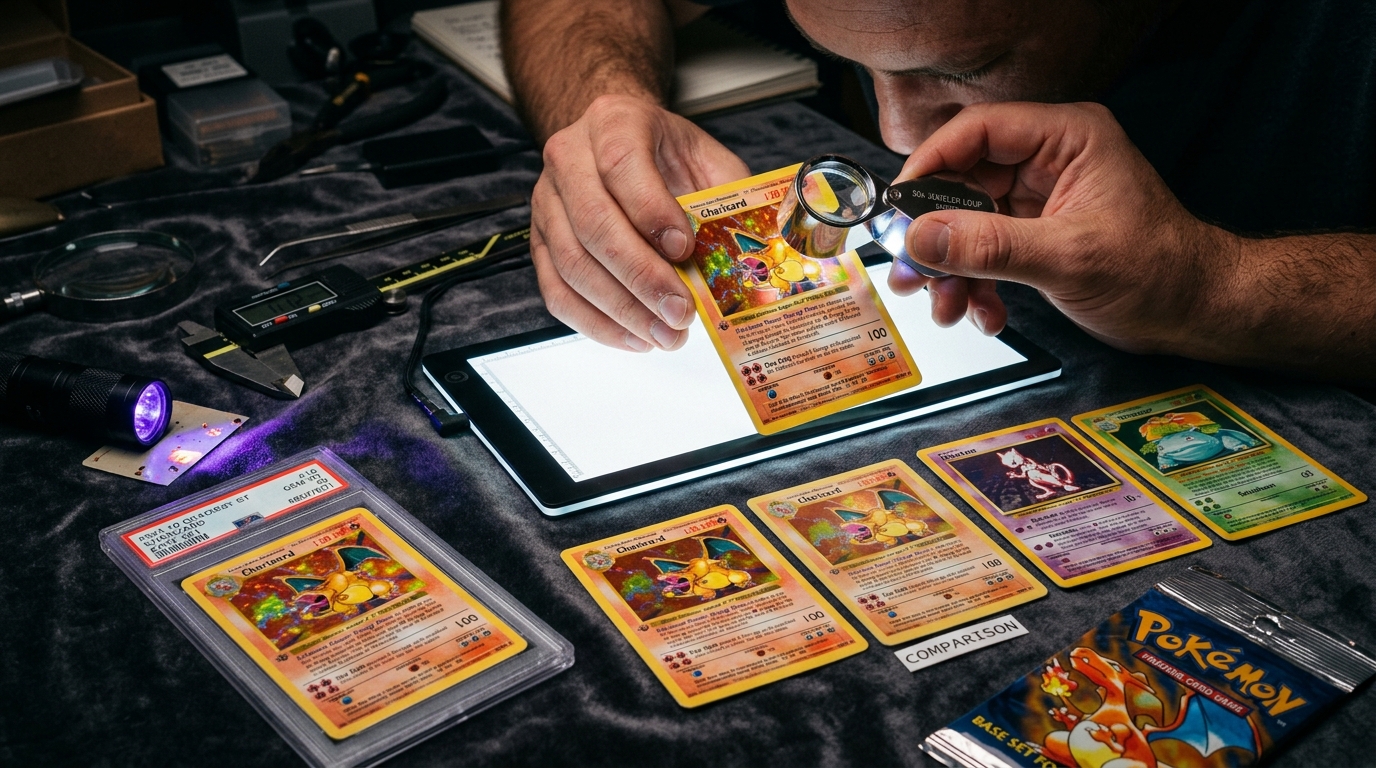
How to Spot Fake Pokemon Cards: 2026 Authentication Guide
The counterfeit Pokémon card market has never been more sophisticated than it is in 2026. With the May 22 release of Chaos Rising flooding the market with high-value Mega Evolution ex cards and Special Illustration Rares, and Pokémon's 30th anniversary on February 27, 2026 reigniting vintage demand, counterfeiters have followed the money — and gotten dangerously good at their craft.
Since October 2025, authorities have logged at least 477 Pokémon-related scam cases with confirmed losses exceeding $958,000. Fake booster boxes, counterfeit sealed ETBs, and even convincing replica PSA, BGS, and CGC slabs are circulating on major platforms. Whether you're a parent buying a birthday gift, a returning collector chasing nostalgia, or an investor eyeing the latest Mega Greninja ex, knowing how to authenticate cards is now a non-negotiable skill.
This guide breaks down every reliable authentication method for 2026 — from the classic light test to modern slab verification — with specific examples pulled from the sets counterfeiters are targeting right now.
Why Fake Pokemon Cards Are Harder to Spot in 2026
Counterfeiting used to be easy to detect. A blurry image, misaligned holo pattern, or laughably bad text alignment gave away most fakes within seconds. That era is over.
Modern counterfeit operations now use:
- High-resolution offset printing that mimics the dot pattern of official cards
- Correct cardstock thickness (0.30mm–0.33mm) sourced from Chinese paper mills
- Textured foil applications that replicate rainbow, cosmos, and cracked-ice holo patterns
- UV-reactive inks to defeat basic blacklight tests
- Replica PSA/BGS/CGC slabs with cloned label designs and even fake QR codes
The 2026 Bitdefender Pokémon card scam report specifically flagged fake grading cases as one of the fastest-growing threats in the hobby. This means the old advice — "just buy graded" — no longer offers automatic protection.
The Sets Counterfeiters Are Targeting in 2026
Before diving into authentication techniques, know your battlefield. According to market trend data, these are the most heavily counterfeited categories right now:
- Chaos Rising Mega Evolution ex cards — especially Mega Greninja ex, Mega Charizard ex, and Special Illustration Rares
- Mega Evolution – Ascended Heroes (January 2026) — the set that triggered the initial 2026 scam wave
- Base Set Charizard — perennial target, with 30th anniversary demand pushing prices higher
- Trainer Gallery hits from Scarlet & Violet-era sets
- Sealed booster boxes and ETBs from vintage and modern high-demand sets
If you're buying anything from these categories, apply every test below.
The 10-Step Physical Authentication Checklist
1. The Light Test (Rip Test Alternative)
Genuine Pokémon cards contain a thin black opaque layer sandwiched between the front and back cardstock. Hold the card up to a bright light or flashlight:
- Real card: Almost no light passes through. The card appears solid black or dark gray.
- Fake card: Light passes through easily, and you may see the reverse image faintly.
This is still the single most reliable non-destructive test in 2026. Counterfeiters have improved cardstock, but replicating the black core layer at scale remains cost-prohibitive for most fake operations.
2. Cardstock Feel and Weight
Official Pokémon cards weigh approximately 1.7–1.9 grams and have a specific stiffness. If you have a card you know is real (from a trusted local game store pack), keep it as a reference:
- Real: Firm but flexible, snaps back when gently bent
- Fake: Often feels either too flimsy (paper-like) or too rigid (plastic-like)
3. Texture and Holo Patterns
Modern Pokémon cards use specific holo patterns per rarity tier:
- Cosmos holo (older sets) — random starfield pattern
- Cracked ice — sharp geometric lines
- Rainbow foil / textured Special Illustration Rares — raised, tactile texture you can feel with your fingernail
Run your fingernail across a suspected fake Mega Greninja ex Special Illustration Rare. Authentic textured cards have a distinct raised feel following the artwork contours. Fakes typically feel completely flat or have uniform texture across the entire card.
4. Font and Typography Check
Compare the font weight, kerning, and letter shapes to a confirmed real card of the same set. Common giveaways:
- HP numbers that are too thick or thin
- Attack damage numbers with wrong proportions
- Energy symbols that appear slightly "off" in size or color saturation
- Copyright text at the bottom that's blurry, misaligned, or uses the wrong year
5. Color Saturation and Print Quality
Zoom in with a jeweler's loupe (10x magnification) or your phone's macro camera:
- Real cards: Sharp, precise dot pattern with clean color transitions
- Fake cards: Often show blurred edges, dot patterns that are too large or inconsistent, and muddy color transitions in gradients
Pay special attention to the Pokémon's eyes and small details in the artwork — these are frequently where counterfeit print quality breaks down first.
6. Back-of-Card Blue Gradient
The blue Poké Ball gradient on the card back is a classic tell:
- Real: Smooth transition from light to dark blue with the Poké Ball centered
- Fake: Often too dark, too saturated, or the gradient bands are visible
Also check the yellow border around the back — it should be the same width on all sides.
7. Edge and Cut Quality
Official cards have precise, clean edges. Examine under magnification:
- Real: Uniform white edge (or black for newer premium cards), consistent thickness
- Fake: Rough, feathered, or inconsistent edges; sometimes edges are dyed to hide the wrong core color
8. Set Symbol and Rarity Marks
Each set has a unique symbol in the bottom-right of the card. Cross-reference with official set images:
- Wrong symbol shape or positioning
- Missing rarity dot/diamond/star
- Regulation mark letter (currently "H" and "I" for standard-legal cards in 2026) missing or wrong
9. Bend Test (Use Sparingly)
Genuine cards flex gently and return to shape. Fakes often crease permanently or feel like they'll snap. Only perform this on cards you strongly suspect are fake — never on a potentially real card you're considering purchasing.
10. Compare Against Verified Images
Before buying any high-value card, cross-reference against verified images. You can check current market listings and card details for any card by searching card prices on Pokemon Price Tracker to see high-resolution reference images alongside real sales data.
How to Spot Fake PSA, BGS, and CGC Slabs in 2026
Graded cards were once considered counterfeit-proof. That protection has eroded significantly. Here's how to verify slabs in 2026:
PSA Slab Authentication
- Check the cert number online — Every PSA slab has a certification number. Enter it on PSA's official verification tool. A real cert will pull up matching images and grade details.
- Compare the cert image to the card in the slab. Counterfeiters sometimes reuse real cert numbers with different cards inside.
- Inspect the label font — PSA uses very specific typography. Blurry text, wrong font weight, or slightly off-color red labels are red flags.
- Examine the slab seams — Real PSA cases have precise, tight seams. Fakes often show glue residue, uneven welding, or visible gaps.
- Check the hologram/security features — Modern PSA slabs include security elements that shift under light.
BGS and CGC Slab Verification
Both companies offer online cert verification tools. Always:
- Match the cert number to the card shown on the verification page
- Verify subgrade breakdowns match the label
- Compare label design to current official examples (both companies have updated designs over the years)
The Population Report Cross-Check
One underused authentication technique: check population data for the specific card and grade. If a seller claims to have a PSA 10 of a card where only 12 exist in that grade, and the same seller has multiple listings, that's suspicious. Legitimate high-grade populations are typically distributed across many owners.
Where Fake Cards Come From: The 80% Rule
Market research indicates that approximately 80% of confirmed counterfeit cases trace back to just four channel patterns:
- Cheap "booster boxes" on AliExpress, Wish, and Temu — If a Chaos Rising booster box costs $40 when the MSRP is $160+, it's fake. No exceptions.
- Facebook Marketplace sellers with under 50 friends — Throwaway accounts are the #1 counterfeit distribution channel
- Unauthenticated eBay listings from new sellers — Especially those with zero feedback or feedback from other card sales that show suspicious patterns
- In-person cash deals from strangers — No recourse, no verification
Safer Buying Channels
- Local game stores (LGS) with direct distributor relationships
- TCGplayer sellers with high feedback and Direct-eligible status
- eBay sellers with 1,000+ feedback and specific Pokémon card specialization
- Authenticated auction houses for high-value vintage
- Sealed products purchased directly from major retailers (Target, Walmart, Costco) — though always verify shrinkwrap authenticity
Authenticating Sealed Products in 2026
Counterfeit sealed product is arguably the most dangerous 2026 trend because buyers often don't discover the fraud until they open packs and find fake cards inside — by which point returns are impossible.
Booster Box Red Flags
- Shrinkwrap seams: Real Pokémon shrinkwrap has precise, tight seams. Fakes often show loose, wrinkled, or double-wrapped shrinkwrap
- Weight: Counterfeit boxes are frequently lighter than genuine product
- Print quality on the box: Blurry logos, wrong Pokémon on the artwork, or off-color box printing
- Rip strip location and function: Real booster boxes have specific rip-strip mechanisms
- Booster pack alignment inside (if you can peek through packaging): Real packs are uniformly stacked
Before buying sealed, cross-reference current market prices for sealed product prices — if the price is dramatically below market average, treat it as fake until proven otherwise.
ETB (Elite Trainer Box) Verification
- Official ETBs have specific dimensions and box texture
- The included dice, damage counters, and sleeves have distinctive quality
- Booster packs inside should match the outer box's set exactly
Specific 2026 Counterfeit Examples
Fake Mega Greninja ex Special Illustration Rare
The Special Illustration Rare Mega Greninja ex from Chaos Rising is one of the most counterfeited single cards of 2026. Common tells on fakes:
- Texture pattern is flat or uniformly grainy instead of following the artwork
- Water splash detail in the artwork appears blurry under magnification
- HP number font weight is slightly thicker than official
- Back-of-card blue gradient runs too dark
Fake Chaos Rising Booster Boxes
Reports from March–May 2026 identified counterfeit Chaos Rising boxes circulating primarily through Facebook Marketplace and overseas e-commerce. Key tells:
- Weight approximately 15–20% below genuine
- Set logo on the box has slightly wrong proportions
- Shrinkwrap is thicker and shinier than genuine Pokémon shrinkwrap
- Inside packs, when opened, contain cards with wrong holo patterns
Fake 30th Anniversary Vintage Reprints
With 30th anniversary hype driving Base Set prices upward, counterfeit Base Set Charizards have flooded the market. The light test remains the most reliable defense — fakes almost universally fail the black-core-layer test.
Tools Every Collector Should Own in 2026
Build a basic authentication kit:
- 10x jeweler's loupe ($8–15) — for print quality inspection
- UV/blacklight flashlight ($10–20) — for detecting some (but not all) fakes
- Bright LED flashlight — for the light test
- Digital jewelry scale (0.01g precision, ~$15) — for weighing cards and sealed product
- Reference cards — keep a few known-authentic commons from each modern set as tactile references
- A phone with macro camera — for high-resolution photo comparison
What to Do If You've Been Sold a Fake
- Document everything — high-resolution photos of the card, packaging, and any communications with the seller
- File a chargeback through your credit card or PayPal within the dispute window
- Report the seller to the platform (eBay, TCGplayer, Facebook, etc.)
- Report to authorities for high-value cases — the FTC, IC3, or local equivalents
- Never resell a card you know or suspect is fake, even at a loss
Investment Considerations
Authentication skill is arguably the highest-ROI knowledge in the Pokémon card hobby right now. A single successful fake detection can save you hundreds or thousands of dollars. Conversely, buying one fake high-value card can wipe out years of collecting gains.
Before investing significant money in graded cards, use tools like our Grading ROI Calculator to determine whether raw purchases and self-submission make more sense than buying pre-graded — reducing your exposure to counterfeit slabs entirely.
Note: Past performance does not guarantee future results. Always do your own research before making investment decisions.
Key Takeaways
- The 2026 counterfeit market is more sophisticated than ever, with fake singles, sealed product, and even graded slabs in circulation
- The light test remains the single most reliable authentication method
- Cross-reference every high-value purchase against verified images, market prices, and population data
- Chaos Rising Mega Evolution ex cards, 30th anniversary vintage, and sealed booster boxes are the most-targeted categories
- 80% of counterfeits come from four channel patterns: AliExpress/Wish, Facebook Marketplace, unvetted eBay sellers, and cash deals
- Always verify slab certification numbers directly on PSA, BGS, or CGC's official verification tools
- Build a basic authentication kit — the tools cost less than a single mid-tier card
Authentication isn't paranoia — it's the price of admission for collecting in 2026. Take the extra 60 seconds to verify. The peace of mind, and the money saved, is always worth it.
Pokemon Price Tracker
Market Analyst
Related Articles
CGC vs PSA in 2026: Which Grader Holds Value Best?
PSA's 2026 Value tier pause has reshaped the grading landscape. We compare CGC vs PSA on pricing, turnaround, resale premiums, and market share to help you choose the right grader for every submission.
Pokemon Price Tracker
Best Pokemon Cards to Grade in 2026 for Maximum ROI
Discover the best Pokemon cards to grade in 2026 for maximum ROI. Learn the grading economics, top modern and vintage targets, and the framework to determine which cards are worth submitting to PSA, CGC, or BGS.
Pokemon Price Tracker
Best Pokemon Cards to Invest In 2026: Long-Term Analysis
A data-driven breakdown of the best Pokemon cards to invest in for 2026, from $16M vintage grails to modern alt art sleepers. Learn which cards have the strongest fundamentals, how to approach grading ROI, and how to build a balanced Pokemon card portfolio.
Pokemon Price Tracker
Stay Updated
Subscribe to our newsletter for the latest Pokemon card market trends, investment opportunities, and exclusive insights delivered straight to your inbox.